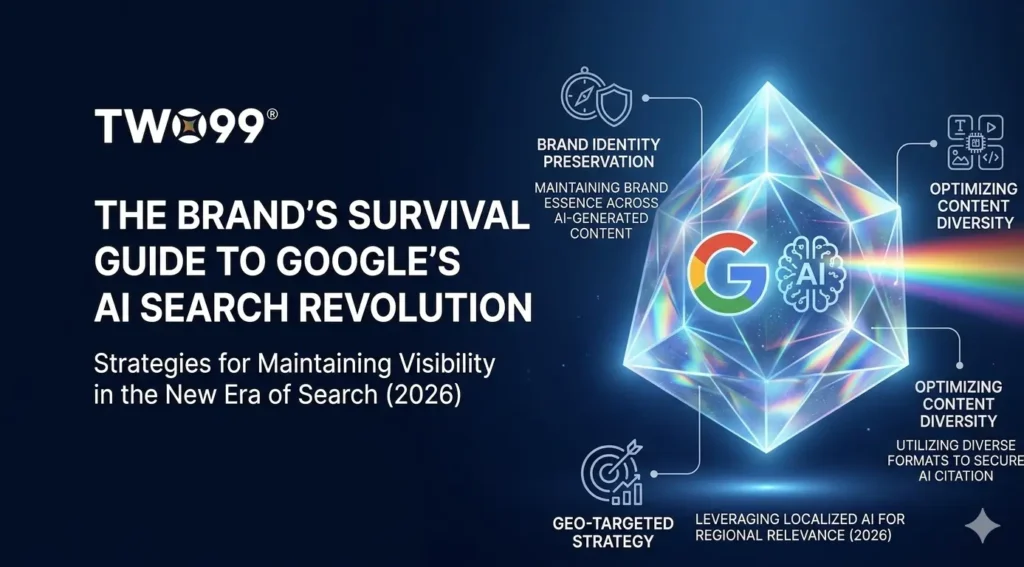
How AI Search Is Reshaping Brand Visibility Forever
Website traffic that held steady for years is starting to dip. Click-through rates on once-reliable keywords are softening. Leads that used to come from organic search are showing up with no clear source. And Google Search Console looks roughly the same, so nobody’s sounding any alarms.
What’s happening isn’t a penalty or a technical glitch. It’s something far more fundamental. Google Search is no longer primarily a directory. It’s becoming a conversational intelligence system, one that reads your content, reasons over it, and presents its own synthesized answer to the user, often without requiring a single click.
This is Google’s AI search revolution. And if your brand hasn’t adapted, you’re not losing ground gradually. You’re losing it invisibly.
This guide is about surviving, and thriving, through that shift.
Understanding What Just Changed (And Why It Matters More Than Any Update Before)
Think back to the last major SEO disruption that genuinely scared brands: Penguin, Panda, the mobile-first indexing shift. Each of those changed how Google evaluated content. But the fundamental contract stayed the same, a user searches, Google returns a list of links, and the user clicks through to a website.
That contract is now being renegotiated.
With AI Overviews and AI Mode, Google now generates direct, structured, sourced answers at the top of search results. A user searching for “how to lower customer acquisition cost for a D2C brand” might get a full, five-point breakdown written by Google’s AI workflow, with citations to three or four websites embedded in the response, before a single organic listing appears.
For users, this is genuinely useful. For brands? It’s a fork in the road.
The brands that appear inside those AI-generated answers become trusted, referenced sources. The brands that don’t appear have effectively ceased to exist at the moment of that search, even if they rank organically just below the fold.
The question is not whether AI search will affect your brand. It already is. The question is whether you’re positioned to benefit from it or be buried by it.
What Google’s Own Playbook Reveals
Google published its official guidance on optimizing for generative AI search features through Google Search Central. It’s unusually candid for Google documentation, and buried in its technical language are a few truths that should reshape how brands think about digital presence.
Truth #1: The Algorithm Has a Long Memory — And It Rewards Reputation, Not Tricks
Google’s AI features are not a separate system running on different rules. They are built on top of the same core Search ranking and quality infrastructure that has governed Google for years.
This means the brand that spent the last three years building genuine topical authority, earning quality backlinks, and maintaining technical SEO strategy hygiene is, right now, better positioned for AI visibility than the brand that chased quick wins.
AI Overviews use a process called Retrieval-Augmented Generation (RAG): before generating any response, the system pulls real pages from Google’s index using its standard ranking signals. Then it synthesizes from those pages.
If your pages don’t rank with strong authority signals, they won’t be retrieved. If they’re not retrieved, they won’t be cited.
What this means for brands: reputation built through consistent, quality content and genuine authority is the primary currency of AI search visibility.
Truth #2: The Content Most Brands Produce Won’t Make the Cut
Google’s documentation draws a sharp distinction between two types of content, and the gap between them has never mattered more.
Generic content is anything that could be produced by anyone with access to the same set of facts. Top-ten lists built from public data. Category explainers that summarize what Wikipedia already covers. “Comprehensive guides” that are comprehensive in word count but thin in original thought.
Distinctive content is something different: it contains a point of view that could only exist because of a specific person’s experience, a company’s proprietary data, a practitioner’s hard-won knowledge, or a genuinely original synthesis of information.
Google’s AI systems are trained on vast amounts of text. They are increasingly good at recognizing content that adds nothing new to what’s already available.
Brands that publish commodity content at scale are not building an asset. They’re building a liability.
The brands that will dominate AI search over the next few years are the ones producing content that is genuinely hard to replicate — rooted in real data, real experience, real expertise, and a distinct point of view.
Read Also: Google Reports a New Wave of AI Users
Truth #3: Technical Access Is the Floor, Not the Ceiling
There’s no point in having brilliant content if Google’s systems can’t find, read, and understand it.
The AI features in Google Search only serve content from pages that are crawlable, indexable, and eligible to appear in standard Google Search results with a snippet.
This sounds obvious. But a surprising number of brands are unknowingly blocking their best content through misconfigured robots.txt files, accidental noindex tags, slow JavaScript rendering that Googlebot partially misses, or bloated site architectures that cause crawl budget to be wasted on low-value pages.
Technical SEO is the floor. It doesn’t get you into AI answers on its own, but without it, none of the content strategy in the world will matter.
The Four Mistakes Brands Are Making Right Now
Mistake 1: Obsessing Over LLMS.txt and “AI-readable” File Formats
A wave of vendors and consultants began selling the idea that adding a special file to your website would signal to language models how to use your content.
Google’s guidance is explicit: there is no such file that provides any special treatment in Google’s systems.
Mistake 2: Buying Brand Mentions to Game AI Responses
The idea here is that if enough blogs, forums, and third-party sites mention your brand or product, AI systems will feature you more prominently.
The problem is that Google’s spam detection systems apply to these inauthentic signal networks too.
Mistake 3: Rewriting Content Specifically “For AI”
Some brands are restructuring their content into robotic formats believing AI systems prefer this style.
Google is clear: AI systems understand synonyms, context, and intent well enough that writing style doesn’t need to change for AI.
Mistake 4: Creating Dozens of Thin Pages
AI search makes thin, repetitive pages less effective, not more.
Depth on a single well-constructed page beats breadth across many shallow ones.
What Survival Actually Looks Like
Brands that will win in the AI search era are making a strategic shift now.
They are auditing content ruthlessly for uniqueness. They are investing in expertise instead of volume. They are treating technical SEO as infrastructure, not housekeeping.
They are also optimizing structured product data, local visibility, and accessibility to prepare for the rise of agentic AI systems that browse and transact on behalf of users.
Two99: The Agency Built for the AI Search Era
While many agencies were still focused on traditional SEO tactics, Two99 was already building infrastructure for AI-driven search visibility.
Two99 operates as a consortium of specialized agencies focused on AI SEO, Technical AI SEO, and LLM Optimization.
Their approach aligns closely with the realities Google itself outlines: authority, technical accessibility, and authentic credibility.
Through solutions like Genshark AI and BEETLE, Two99 helps brands identify authority gaps, create genuinely distinctive content, and improve visibility across AI-powered search ecosystems.
Their work spans industries including fintech, e-commerce, Web3, and real estate, with brands like Reckitt, Dabur, SBI, Godrej, and Lodha among their clients.
The Honest Assessment: Where Does Your Brand Stand?
- Does your content offer a genuinely unique perspective?
- Are authoritative websites organically citing your work?
- Is your technical SEO foundation healthy and crawl-efficient?
- Are your product feeds and business profiles fully optimized?
- Do you know whether your brand appears inside AI-generated answers?
If the answers are uncomfortable, you are not alone — but the window for easy adaptation is shrinking.
The Bottom Line
Google’s AI search revolution is not a temporary disruption. It’s a structural shift in how information reaches people, and how brands reach customers.
Brands that continue optimizing for the old search model risk becoming invisible.
Brands that invest in authority, technical excellence, structured data, and genuinely valuable content will find AI search to be one of the most powerful distribution channels they’ve ever had.
Survival belongs to brands willing to stop playing yesterday’s game and start building for the one that already exists.