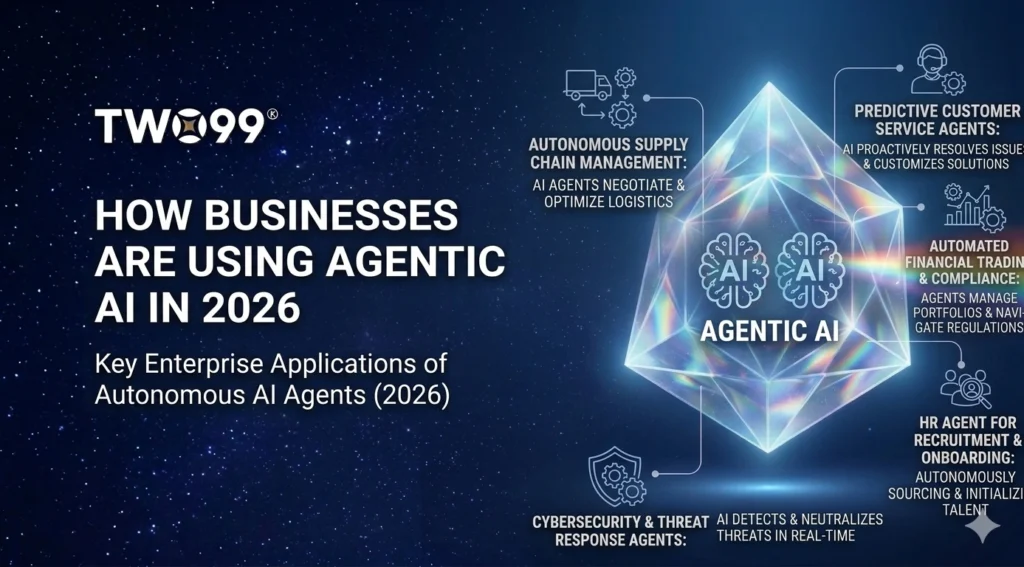
In 2026, businesses are moving beyond simple AI chatbots and entering the era of Agentic AI — intelligent systems capable of planning, reasoning, and completing tasks autonomously.
Unlike traditional AI tools that only generate responses, Agentic AI systems can take actions, use tools, manage workflows, and execute multi-step operations with minimal human supervision. This shift is transforming how companies operate across marketing, customer support, software development, research, and internal automation.
As competition grows and operational efficiency becomes more important, businesses are increasingly adopting Agentic AI to automate repetitive work, reduce costs, and improve productivity.
This guide explores how businesses are using Agentic AI in 2026, the industries being transformed, and why autonomous AI systems are becoming the next major evolution in enterprise technology.
What Is Agentic AI?
Agentic AI refers to autonomous AI systems that can independently:
- Plan tasks
- Make decisions
- Execute workflows
- Use software tools
- Interact with websites
- Analyze information
- Adapt to outcomes
Unlike standard AI chatbots, Agentic AI focuses on execution rather than just conversation.
These systems combine:
- Large language models
- Workflow orchestration
- Memory systems
- Browser automation
- API integrations
- Reasoning capabilities
to perform real operational tasks.
Businesses Are Automating Workflows With Agentic AI
One of the biggest use cases for Agentic AI is workflow automation.
Businesses are now using AI agents to automate repetitive operational tasks such as:
- Generating reports
- Updating CRM systems
- Monitoring dashboards
- Processing tickets
- Scheduling workflows
- Analyzing data
- Sending notifications
Instead of employees manually coordinating these tasks across multiple tools, Agentic AI systems can now manage them autonomously.
For example, a sales AI agent can monitor leads, update customer records, summarize meetings, generate outreach drafts, and trigger follow-up reminders without constant human input.
This significantly improves operational efficiency while reducing manual administrative work.
Agentic AI Is Changing Customer Support
Customer support is becoming one of the fastest-growing areas for Agentic AI adoption.
Traditional chatbots often struggle with:
- Complex workflows
- Contextual understanding
- Multi-step problem resolution
Agentic AI systems are more advanced because they can:
- Understand customer intent
- Access internal systems
- Retrieve account information
- Process requests
- Escalate issues intelligently
- Complete support workflows
This allows businesses to automate larger portions of customer support operations while maintaining faster response times.
In 2026, many companies are deploying AI agents capable of handling refunds, account troubleshooting, order tracking, appointment scheduling, and customer onboarding with minimal human intervention.
AI Coding Agents Are Increasing Developer Productivity
Software engineering is another industry rapidly adopting Agentic AI.
Modern AI coding agents can:
- Write code
- Debug errors
- Analyze repositories
- Generate documentation
- Run tests
- Suggest optimizations
Tools like Devin, Claude Code, and autonomous development agents are helping engineering teams automate repetitive development tasks.
Rather than replacing developers completely, these systems are increasing productivity by reducing time spent on maintenance and routine coding operations.
Marketing Teams Are Using Agentic AI for SEO and Content
Marketing departments are increasingly using Agentic AI systems to automate content operations and SEO workflows.
AI agents can now:
- Research keywords
- Analyze competitors
- Generate content briefs
- Monitor SERP changes
- Optimize metadata
- Track ranking performance
- Create content drafts
This allows businesses to scale content production more efficiently while improving optimization strategies.
Many companies are also using AI agents for:
- Social media planning
- Trend analysis
- Audience research
- Campaign automation
- AI-generated reporting
Browser Automation Is Becoming a Major Business Use Case
Many business workflows still depend heavily on web-based software platforms.
Agentic AI systems can now interact with browsers similarly to humans by:
- Navigating websites
- Filling forms
- Downloading reports
- Updating dashboards
- Processing online workflows
This is becoming especially useful for:
- Finance operations
- HR systems
- CRM management
- Research workflows
- eCommerce operations
Agentic AI Is Driving the Rise of Autonomous Operations
One of the most important trends in 2026 is the movement toward autonomous business operations.
Businesses increasingly want AI systems that can:
- Monitor operations continuously
- Detect issues proactively
- Generate insights automatically
- Coordinate workflows
- Trigger actions independently
For example, an AI agent may monitor sales performance daily, detect unusual drops, analyze customer behavior, generate reports, and notify teams automatically without manual supervision.
This shift is changing how organizations think about productivity and operational scalability.
Challenges Businesses Still Face With Agentic AI
Despite rapid progress, Agentic AI still has limitations.
Businesses continue facing challenges around:
- Reliability
- Hallucinations
- Workflow errors
- Security risks
- AI governance
- Privacy concerns
- Compliance issues
Human oversight remains essential for many high-stakes workflows.
Most businesses currently use Agentic AI as a collaborative system rather than fully autonomous infrastructure.
The Future of Agentic AI in Business
The future of Agentic AI looks extremely significant.
Industry experts believe AI agents will increasingly become:
- Digital employees
- Workflow coordinators
- Operational assistants
- Intelligent automation systems
Instead of opening multiple software tools manually, businesses may eventually rely on AI agents to coordinate operations across platforms automatically.
This could reshape enterprise software, digital operations, productivity systems, customer experiences, and business automation over the next decade.
Final Thoughts
Agentic AI is rapidly becoming one of the most important technology trends in 2026.
Businesses are no longer interested only in AI-generated responses. They want AI systems capable of executing tasks, automating workflows, and improving operational efficiency.
From customer support and coding to marketing, browser automation, and workflow orchestration, Agentic AI is transforming how organizations operate.
At the same time, human oversight, strategic thinking, and creativity still remain essential.
The future will likely involve collaboration between humans and autonomous AI systems rather than complete replacement.
But one thing is becoming increasingly clear: the next generation of business automation will be powered by Agentic AI.
FAQs
What is Agentic AI?
Agentic AI refers to autonomous AI systems that can plan, make decisions, and complete tasks with minimal human intervention.
How are businesses using Agentic AI?
Businesses use Agentic AI for workflow automation, customer support, coding, SEO, browser automation, and operational management.
What industries are adopting Agentic AI?
Industries using Agentic AI include software development, marketing, customer service, eCommerce, finance, and enterprise operations.
Is Agentic AI replacing human workers?
Agentic AI is mainly automating repetitive tasks while helping employees improve productivity and efficiency.
What are examples of Agentic AI tools?
Popular Agentic AI tools include Devin, CrewAI, LangGraph, AutoGPT, and browser automation agents.
Key Takeaways
- Agentic AI enables businesses to automate complex workflows by planning, reasoning, and executing tasks with minimal human intervention.
- Companies are using Agentic AI across customer support, software development, marketing, and business operations to improve efficiency.
- AI agents can interact with tools, websites, APIs, and internal systems, making them more powerful than traditional AI chatbots.
- As Agentic AI adoption grows, businesses that combine automation with human oversight will gain a significant competitive advantage in 2026 and beyond.