With SearchGPT, imagine your next customer never Googles your business. They don’t scroll through ten websites, compare multiple agencies, read endless reviews and then make a shortlist. They simply ask, “Which company should I choose for this?” And an AI gives them three names. The uncomfortable question is: is your business one of them?
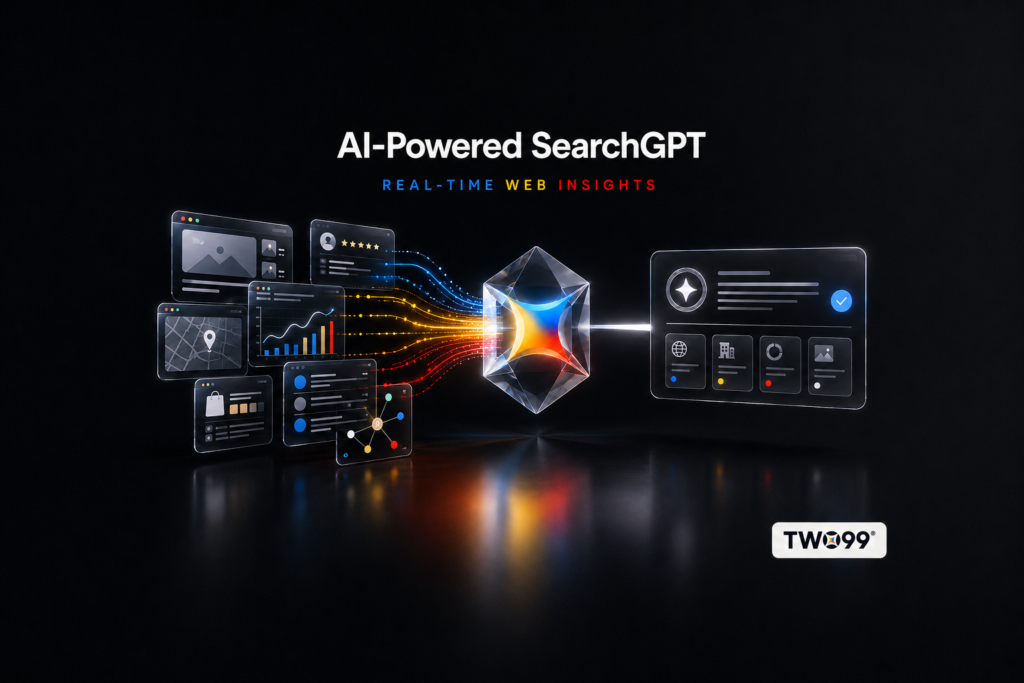
That is the real significance of SearchGPT. It is not simply another search product; it represents a shift from searching for information to asking for an answer. OpenAI launched SearchGPT as a prototype in July 2024 to combine conversational AI with current information from the web. Its strongest capabilities were later brought into ChatGPT Search, allowing users to search the web, receive answers with sources and continue asking questions within the same conversation.
For businesses, SearchGPT changes the question completely. For years, we have asked, “How do we rank?” Now, we need to start asking, “How do we become the answer?”
What exactly is SearchGPT?
Let’s put the technical language aside. Traditional search is straightforward, while SearchGPT changes the sequence: you ask a question, receive a list of links, open those links, compare information, and eventually make a decision. SearchGPT introduced a more conversational experience where the system can search the web, understand the information it finds, bring it together and give you a direct response supported by sources.
Imagine someone searching for a digital marketing agency. Earlier, they might type “best digital marketing agencies in Gurgaon”, open ten websites and begin comparing them. With AI-powered search, the question can become much more specific: “Which digital marketing agency would be best for a real estate company in Gurgaon that wants qualified leads?” The customer can then ask, “Which ones have worked with real estate brands?” and “Which one would you recommend?”
That is no longer just search. That is decision-making through conversation.
QUICK FACTS: SearchGPT At A Glance
SearchGPT was introduced by OpenAI in July 2024 as a prototype, rather than a permanent standalone search engine. OpenAI subsequently incorporated its strongest capabilities into ChatGPT Search. ChatGPT can search the web for current information, provide source links and allow users to continue their research through follow-up questions. OpenAI also guides publishers who want their websites to be discoverable through ChatGPT Search, including access for OAI-SearchBot.
The bigger takeaway is that businesses shouldn’t focus only on SearchGPT as a product. The real opportunity is preparing for the wider movement towards AI-powered discovery, where customers increasingly ask an AI to research, compare and recommend rather than simply browse search results themselves.
Why Should Your Business Care?
SearchGPT matters because your customer is changing the way they research. Think about the last important purchase you made. You probably checked different websites, compared prices, looked at reviews, watched videos and searched for opinions before making a decision. Now imagine asking an AI to perform much of that research for you.
Instead of spending an hour comparing five companies, your customer could ask an AI to shortlist the best options based on their specific requirements. Your business is therefore no longer competing only for a click. It is competing to be included in the answer.
This creates a very different kind of digital competition. Being number one for a keyword may still matter, but it is no longer the complete picture. Your business also needs to be understandable enough, credible enough and relevant enough to be considered when an AI generates an answer.
Your Website Is No Longer Just A Website
For years, businesses have treated websites like digital brochures. You have a homepage, an about page, service pages, some blogs and a contact form. But in an AI-led search environment shaped by SearchGPT, your website has another job: it needs to explain your business clearly.
If your website says, “We are a leading organisation providing innovative and transformative solutions,” it doesn’t really tell anyone anything. Compare that with, “We help D2C brands increase online revenue through performance marketing, e-commerce technology and conversion optimisation.” The second statement immediately tells you what the business does, who it serves and what outcome it focuses on.
That clarity matters because AI systems need context. They need to understand what your business is, what you offer, who you serve and why someone should consider you.
TRY THIS: Ask AI About Your Business
There is a simple SearchGPT readiness test you can run today. Open ChatGPT and ask, “What does [your company] do?” Then ask, “What is [your company] known for?” Follow it with, “Who are the main competitors of [your company]?” Finally, ask, “Would you recommend [your company] for [your target customer]? Why?”
Now look at the answers carefully. Is the information accurate? Does AI understand your biggest strengths? Does it know your key products or services? Does it understand your positioning? Does it identify the right competitors?
If the answer isn’t what you expected, don’t look at it as a failure. Look at it as a diagnostic of your digital presence. It shows you how clearly the internet currently understands your business.
So, What Does “SearchGPT-Ready” Actually Mean?
Being SearchGPT-ready doesn’t mean installing a plugin or publishing hundreds of AI-generated blogs. It means building a digital presence that is discoverable, understandable, credible, relevant and consistent.
Your technical infrastructure needs to work. Your website architecture needs to make sense. Your content needs to answer real questions. Your business information needs to be consistent across platforms. Your claims need to have proof behind them. Your brand needs authority beyond its own website.
OpenAI’s publisher guidance explains how OAI-SearchBot accesses websites that want their content to be discoverable through ChatGPT Search. But technical accessibility is only the starting point. Getting discovered is one thing; being worth recommending is another.
CONTENT NEEDS TO BECOME MORE USEFUL
Preparing for SearchGPT does not mean publishing another article titled “10 Benefits of Digital Marketing.” What customers actually want to know is how much they should spend, how long results take, whether SEO or paid advertising is right for them, how to choose an agency and what results they should realistically expect.
This changes how businesses should think about content. Instead of asking, “What keyword should we target?”, ask, “What question is our customer trying to answer?” That small change can completely transform a content strategy.
The goal isn’t to create more content. The goal is to create more useful information.
TIP: Don’t Create Content Just Because AI Exists
One of the biggest SearchGPT mistakes businesses can make is producing large volumes of generic content simply because they want to appear in AI search. That approach misses the point.
Create content because your customers have questions. Explain things better than your competitors. Share original insights. Build useful resources. Publish genuine case studies. Answer difficult questions. Give people information they can actually use.
Better information will always be more valuable than more information.
YOUR BRAND NEEDS MORE THAN ITS OWN WEBSITE
SearchGPT makes another part of the equation more important. Your website can say that you’re an expert, but what does the rest of the internet say?
If your website says you’re a market leader, but there are no credible mentions, reviews, case studies, media references or independent sources supporting that claim, there is a gap between what you say and what can be verified.
Your website should tell your story. Your wider digital presence should help prove it.
That means your website, social profiles, business listings, reviews, media coverage, case studies and third-party mentions should collectively create one consistent understanding of your business.
QUICK TIP: PROOF BEATS PROMISES
Consider two agencies. The first says, “We are India’s leading digital marketing agency.” The second says, “We helped an education business increase qualified leads by 3X, increase enrolments by 20% and reduce cost per lead by 40%.”
Which one gives you more confidence?
The second one has context, specificity and measurable outcomes. It doesn’t just tell you that the agency is good; it gives you a reason to believe it.
TWO99 itself uses outcome-led case studies to demonstrate measurable business results, including examples around qualified leads, enrolments and cost efficiency.
The lesson is simple: don’t just tell the internet you’re good. Give it something meaningful to understand about your expertise.
THIS IS WHERE TWO99 COMES IN
At TWO99, we don’t look at SearchGPT or AI search as another isolated SEO service. We see it as a digital ecosystem challenge.
You can’t make a business AI-ready by changing one blog or adding structured data to a few pages. Your technology needs to work. Your website needs to make sense. Your content needs to answer questions. Your brand needs to be consistent. Your authority needs to be visible. Your data needs to support your claims.
That is why we see TWO99 as a facilitator.
We bring the different parts together so that your business becomes easier to discover, easier to understand and easier to trust.
HOW TWO99 MAKES YOUR BUSINESS READY
We start with the most important thing: your business. Before looking at keywords, we understand your products, customers, market, competitors, positioning, differentiators and goals. We don’t want to make your business sound like everyone else. We want to make what makes you different easier to discover.
Then we assess SearchGPT readiness across your digital ecosystem. We examine your website, content, technical foundation, SEO, brand presence, reviews, case studies, third-party mentions and competitor visibility. The question is straightforward: if someone asked AI about your business today, would there be enough credible information available for it to give a strong answer?
Once we know the gaps, we start fixing them. Maybe your website architecture needs restructuring. Maybe your service pages are too generic. Maybe your content doesn’t answer customer questions. Maybe your business information is inconsistent across platforms. Maybe your authority isn’t visible enough. Maybe you don’t have enough proof.
There isn’t one universal AI-search solution.
We identify the actual problem and build around your business.
CASE STUDY: WHY BUSINESS PROOF MATTERS
Let’s take a simple example. Imagine two companies are being considered by an AI for a customer recommendation.
Company A says, “We provide innovative, world-class solutions.”
Company B says, “We helped a growing business reduce its acquisition cost by 40% while increasing qualified leads by 3X.”
Company B has given the digital ecosystem something far more useful: a specific problem, a measurable result and evidence of capability.
That is the kind of information that strengthens a business’s digital identity. It also explains why TWO99’s approach to case studies focuses on business outcomes rather than simply listing services.
THE FIVE THINGS YOUR BUSINESS SHOULD GET RIGHT
First, technical accessibility. Your website needs to be crawlable, indexable and structured properly so search systems can access and understand your information.
Second, useful content. Your website should answer the real questions customers have before they buy.
Third, a clear digital identity. Your website, social profiles, directories and other digital properties should tell a consistent story.
Fourth, authority. Your expertise shouldn’t exist only on your own website. Independent mentions, reviews, publications and industry references can strengthen your overall presence.
Fifth, proof. Case studies, original research, customer stories and measurable outcomes give substance to your claims.
Together, these create something much more valuable than a website that simply ranks.
They create a business that can be understood.
TIPS TO KEEP IN MIND
Don’t abandon SEO. Traditional search and AI search will continue to coexist.
Don’t chase quantity. Ten genuinely useful resources can be more valuable than 100 generic blogs.
Don’t make unsupported claims. If you say you’re the best, show why.
Don’t focus only on your website. Your entire digital footprint contributes to your visibility.
Don’t try to hack AI. Build genuine authority instead.
Don’t write only for machines. AI might discover your business, but people still need to trust it.
QUICK CHECK: IS YOUR BUSINESS SEARCHGPT-READY?
Ask yourself whether a customer can understand exactly what you do within a few seconds. Ask whether your services are clearly explained, whether your website answers real customer questions, whether your business information is consistent everywhere and whether credible third-party sources support your claims.
Ask whether you have meaningful case studies, original insights and measurable results. Ask whether your website is technically accessible and whether you are monitoring how your brand appears across emerging AI search experiences.
If you answered “no” to several of these questions, that doesn’t mean you’re behind.
It means you now know where the opportunity is.
WHY TWO99?
Because we don’t believe the future of search belongs to one platform.
Google will continue to evolve. ChatGPT will evolve. Perplexity will evolve. Gemini will evolve. New AI-powered discovery platforms will emerge.
Your business shouldn’t have to rebuild its digital strategy every time that happens.
Instead, you need a strong foundation that can adapt.
TWO99 brings together capabilities across technology, marketing, AI SEO, e-commerce, cybersecurity and consultancy, allowing businesses to address multiple parts of their digital ecosystem through a connected approach.
So we aren’t asking:
“How do we optimise your business for SearchGPT?”
We’re asking:
“How do we make your business ready for the way customers will discover businesses next?”
That is a much bigger question.
And we believe it deserves a much bigger answer.
Conclusion: The Next Search Result Could Be a Recommendation
Your customer may not be searching for you anymore. They may be asking AI whether they should choose you. That is the real shift businesses need to prepare for. SearchGPT and AI-powered search are changing the journey from search → click → compare to ask → understand → decide. The brands that win in this environment won’t simply be the ones with the most content or the highest rankings. They’ll be the ones AI can clearly understand, confidently validate and naturally recommend. TWO99 is here to facilitate that transition — bringing together technology, content, SEO, strategy, data and digital authority to make your business ready for the next generation of search. Because tomorrow, being visible won’t be enough. Your business needs to be the answer.
People Also Ask: SearchGPT & AI Search FAQs
1. What is SearchGPT?
SearchGPT was OpenAI’s prototype for AI-powered web search. It was designed to provide conversational answers using current information from the web, along with relevant sources. Its strongest capabilities were later integrated into ChatGPT Search.
2. Is SearchGPT different from ChatGPT Search?
SearchGPT was the prototype that helped OpenAI develop its search experience. ChatGPT Search is the evolved version integrated directly into ChatGPT, allowing users to search the web while continuing a conversational interaction.
3. Can my business appear in ChatGPT Search?
Yes. Public websites can potentially appear in ChatGPT Search. Businesses should ensure their websites are accessible to search crawlers, technically sound and filled with clear, useful and authoritative information.
4. Is AI SEO the same as traditional SEO?
Not exactly. Traditional SEO focuses heavily on rankings and search visibility, while AI search adds another layer: making your business information clear, relevant, credible and useful enough to potentially be incorporated into an AI-generated answer.
5. Do I need to create a completely new website for AI search?
Not necessarily. In many cases, your existing website can be made more AI-ready through better technical SEO, information architecture, content, structured information, authority and clearer business positioning.
6. Can an agency guarantee that ChatGPT will recommend my business?
No. AI-generated search results are dynamic and influenced by the query, context and available sources. A credible AI-search strategy should focus on improving your business’s discoverability, relevance, authority and credibility rather than promising guaranteed recommendations.
7. How can TWO99 make my business ready for AI search?
TWO99 approaches AI search as a complete digital ecosystem rather than a standalone SEO activity. We bring together strategy, technology, content, SEO, data, brand presence and digital authority to help make your business easier to discover, understand, trust and ultimately consider across the evolving search landscape.
Key Takeaways
- SearchGPT introduced conversational, source-backed search and later evolved into ChatGPT Search.
- Businesses now compete for inclusion in AI-generated answers, not only traditional search rankings.
- Clear positioning, useful content, technical accessibility and consistent brand information improve AI discoverability.
- Case studies, reviews and credible third-party mentions strengthen authority more than unsupported claims.
- Two99 connects AI SEO, content, technology and digital authority to prepare businesses for evolving AI search platforms.