Why Global Authority Fails to Cross Borders
Imagine a U.S.-headquartered tech enterprise with offices in Tokyo. In the U.S., the company boasts decades of case studies, media coverage, executive profiles, and industry awards. In Japan, they employ top-tier local engineers, maintain key regulatory certifications, and serve prominent local clients.
On paper, they possess deep local authority. But digitally? Their Japanese site is an identical, translated mirror of the U.S. template.
Because the local site lacks localized proof points such as Japanese expert bios, regional customer stories, local press coverage, and local industry memberships AI search engines cannot verify that local expertise exists. When a user in Tokyo asks an AI engine for top technology partners in Japan, the AI synthesizes data from sources that explicitly prove local presence. The enterprise gets overlooked, despite its real-world dominance.
Traditional international SEO relied heavily on technical fixes like hreflang tags to tell search engines which regional URL to show. AI engines, however, do not rely solely on target URLs. They evaluate facts and entities across the web to construct answers. Technical routing is no longer enough; you must explicitly provide localized entity data.
The Fix: What to Keep Global vs. What to Make Local
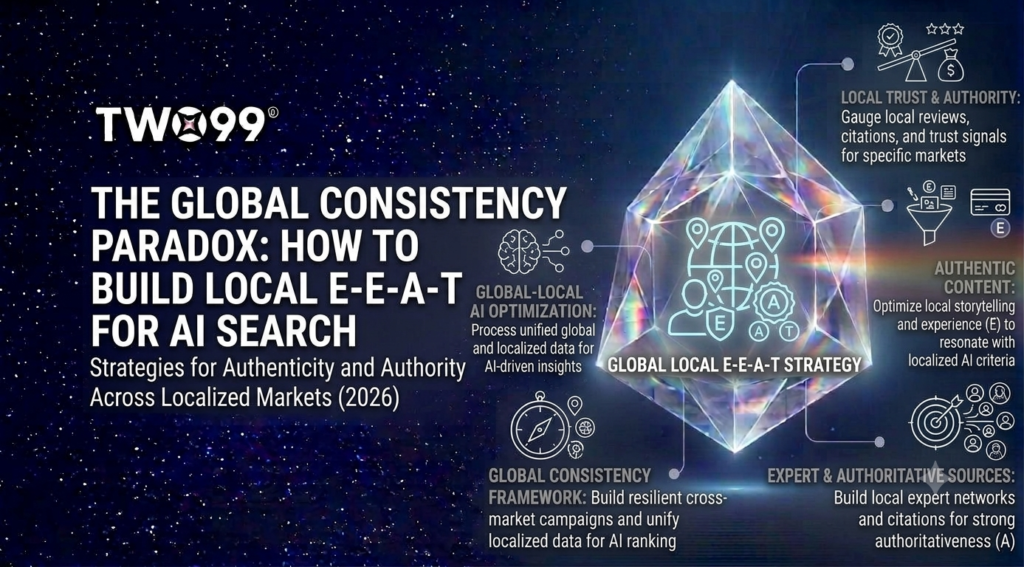
To win in AI-driven search, enterprises must strike a balance. Standardization maintains brand unity and site performance, while local distinction provides the rich data AI search engines need to recommend your brand.
Here is how you should structure your digital footprint:
| Standardize Globally | Distinguish Locally |
|---|---|
| Brand Identity & Values | Local Subject Matter Experts & Author Bios |
| Technical Infrastructure & Schema Frameworks | Regional Case Studies & Client Success Stories |
| Core Product/Service Definitions | Local Regulatory Certifications & Compliance |
| Design Systems & UX Patterns | Country-Specific Industry Associations & Awards |
| Corporate Governance | Local Media Coverage, Reviews & Community Work |
3 Practical Steps to Build Local E-E-A-T for AI Search
1. Highlight Regional Experts and Authors
Do not publish every piece of translated content under a single generic corporate bio or a U.S.-based executive’s name. Introduce local team members who understand regional market nuances, hold local credentials, and participate in regional panels. Add detailed author profiles with local schema markup to establish clear entity relationships.
2. Make Local Proof Points Explicit
AI engines rely on clear entity relationships to connect your brand to a specific market. Publish regional case studies, feature local client testimonials, and highlight country-specific industry certifications on your localized pages. If your company won an industry award in Germany, make sure that achievement lives explicitly on your German domain rather than hiding inside an English press release.
3. Connect to the Local Digital Ecosystem
Building E-E-A-T requires off-page validation. AI search engines synthesize data from local trade journals, regional news outlets, local review platforms, and regional industry directories. Actively build local brand mentions and digital PR footprints in every key market where you operate.
Rethinking Global SEO with two99
Efficiency should never come at the cost of visibility. AI search models do not guess your regional authority they extract and synthesize explicit proof. If your enterprise hides its local expertise behind a uniform global template, AI search tools will simply recommend local competitors who make their authority clear.
At two99, we help enterprise brands balance global scale with hyper-local AI search visibility. Contact our team today to build a modern SEO strategy designed for the AI-first search landscape.
Frequently Asked Questions (FAQs)
1. What is the Global Consistency Paradox in AI search?
The Global Consistency Paradox occurs when an enterprise standardizes its global websites so thoroughly that it strips away the local evidence—like regional case studies, local author bios, and local certifications that AI engines need to verify local expertise and trust (E-E-A-T).
2. Why isn’t traditional international SEO (hreflang) enough for AI search?
Hreflang tags tell traditional search engines which language or regional URL to display in search results. However, AI search engines construct answers by synthesizing factual data from across the web. If your localized page lacks unique, verifiable local evidence, the AI model may not include your brand in its generated response.
3. How does AI search evaluate local E-E-A-T?
AI search engines evaluate local E-E-A-T by looking for explicit signals, such as local expert profiles, regional customer reviews, country-specific compliance and certifications, citations in local media, and active membership in regional trade organizations.
4. Should global enterprises create completely separate websites for each country?
No. Creating entirely separate websites fragments domain authority and increases operational costs. Instead, maintain a unified global architecture and design system, but customize each regional site with market-specific content, proof points, author bios, and local structured data.
5. How can B2B enterprises show local authority in markets where they have small teams?
Even with a small regional footprint, B2B enterprises can demonstrate local E-E-A-T by highlighting regional client wins, showcasing local regulatory compliance, featuring key local team members, and obtaining coverage in regional industry publications.
6. How does two99 help enterprises solve the global vs. local E-E-A-T challenge?
two99 audits your global and regional search footprint to identify where local E-E-A-T signals are missing. We implement structured data frameworks, localize content strategies, and execute digital PR strategies to ensure AI search engines recognize your brand’s authority in every market you serve.