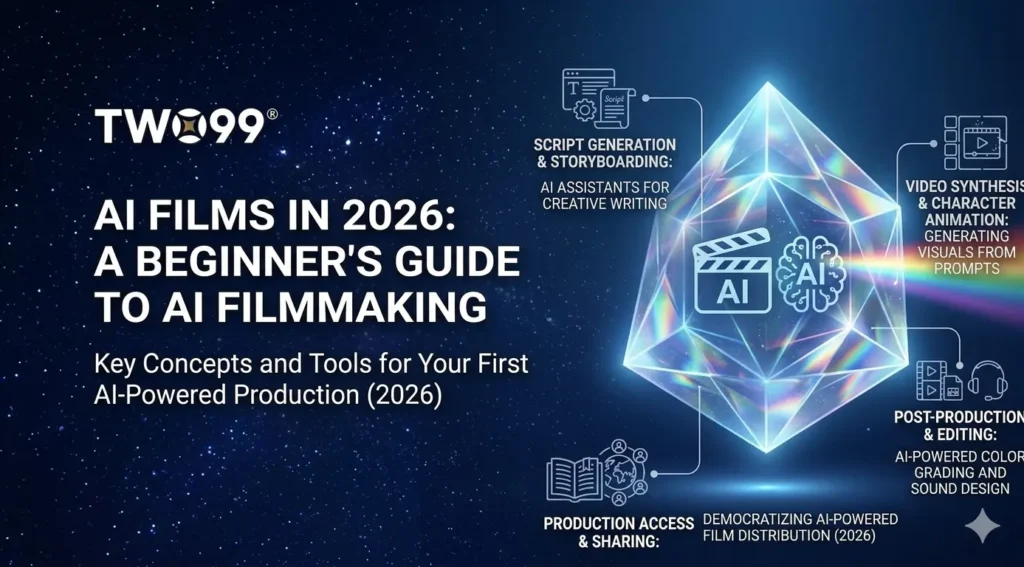
Artificial intelligence is transforming almost every creative industry, but few changes feel as dramatic as what’s happening in filmmaking. In 2026, AI films are no longer experimental internet projects or short social-media clips. AI-generated cinema is becoming a real part of modern filmmaking, influencing everything from scriptwriting and editing to visual effects and video generation.
For beginners, the idea of AI filmmaking can feel confusing. Many people still think AI films are completely made by robots with no human involvement. In reality, AI is becoming more like a creative collaborator rather than a total replacement for filmmakers.
Today, creators, studios, marketers, and independent artists are using AI tools to speed up production, reduce costs, generate ideas, and experiment with storytelling in ways that were impossible just a few years ago.
This beginner’s guide explains what AI films are, how artificial intelligence is changing filmmaking, the best AI filmmaking tools in 2026, and what the future of AI cinema may look like.
What Are AI Films?
AI films are movies, short videos, animations, or cinematic projects created partially or fully using artificial intelligence tools.
These AI systems can help generate scripts, voiceovers, visual effects, storyboards, video scenes, background music, editing transitions, and AI-generated characters.
Instead of relying entirely on traditional production workflows, filmmakers now use AI to automate or enhance parts of the creative process.
For example, an independent creator can now use AI video generation tools to create cinematic scenes without renting expensive equipment or building large production teams.
This shift is making filmmaking more accessible to beginners and creators with limited budgets.
The rise of AI-generated media also connects with larger changes happening across AI automation and content creation. You can internally connect this topic with:
How AI Is Changing Filmmaking in 2026
Artificial intelligence is not just speeding up filmmaking. It is fundamentally changing how films are planned, produced, and distributed.
Traditionally, filmmaking required large production teams, expensive equipment, complex editing software, visual effects studios, and long production timelines.
AI filmmaking tools are reducing many of these barriers.
In 2026, creators can use AI for automated video editing, AI script generation, realistic voice synthesis, AI-powered dubbing, cinematic scene creation, visual enhancement, background generation, and motion tracking.
This allows smaller creators to produce professional-looking content much faster than before.
One of the biggest changes is the rise of text-to-video AI systems. These tools can generate cinematic scenes simply from written prompts. Instead of filming every shot manually, creators can now describe scenes using natural language and generate visual sequences instantly.
This technology is still evolving, but it is already influencing advertising, YouTube content, social media storytelling, and independent filmmaking.
AI Scriptwriting Is Becoming Mainstream
One of the earliest areas where AI entered filmmaking was scriptwriting.
AI writing systems can now help creators brainstorm story ideas, generate dialogue, improve pacing, create character concepts, and summarize plot structures.
This does not mean AI writes perfect movie scripts independently. Human creativity remains essential.
However, AI scriptwriting tools are becoming powerful assistants for overcoming writer’s block, generating first drafts, testing story concepts, and speeding up production workflows.
For independent filmmakers and content creators, this dramatically reduces the time needed to move from idea to production.
The growing role of AI in creative writing also aligns closely with:
AI Video Generation Is Transforming Production
AI video generation has become one of the biggest trends in filmmaking.
Modern AI tools can now create cinematic visuals, animated sequences, realistic environments, digital actors, camera movements, and stylized scenes.
This technology is making high-quality video production accessible to creators who previously lacked professional equipment or large budgets.
For example, AI tools can now generate sci-fi environments, fantasy worlds, cinematic backgrounds, animated sequences, and virtual actors using only text prompts.
This has major implications for YouTubers, indie filmmakers, digital marketers, advertising agencies, and social media creators.
The speed of production is also increasing dramatically. Tasks that previously required weeks of editing and rendering can now be completed in hours.
While AI-generated video still has limitations, the quality improvement between 2024 and 2026 has been massive.
Best AI Tools for Filmmakers in 2026
The AI filmmaking ecosystem is growing rapidly.
Some tools focus on scriptwriting, while others specialize in editing, video generation, visual effects, or voice synthesis.
Popular AI filmmaking tools in 2026 include:
- Runway
- Sora
- Pika Labs
- Descript
- ElevenLabs
- Adobe Firefly
- Midjourney for concept art
- AI editing assistants
These platforms help creators automate repetitive production tasks while also enabling experimental storytelling.
For beginners, AI tools reduce technical complexity significantly. Someone with limited filmmaking experience can now create cinematic content using AI-powered workflows.
This democratization of filmmaking is one of the most important industry shifts happening right now.
Can AI Replace Traditional Filmmaking?
This is one of the most debated questions in the film industry today.
The short answer is no.
AI is changing filmmaking, but it is not fully replacing human creativity.
Films are emotional experiences built around storytelling, direction, performance, culture, and artistic vision. AI can assist with production, but human imagination still drives meaningful cinema.
What AI is replacing are repetitive and technical workflows.
For example, editing assistance, background generation, dubbing, subtitle creation, basic animation, visual cleanup, and production planning can now be automated much faster.
This allows filmmakers to focus more on creativity rather than repetitive production work.
In many ways, AI filmmaking is becoming similar to how digital cameras transformed cinema years ago. The technology changes the workflow, but storytelling remains human at its core.
AI Films and the Future of Hollywood
Hollywood and major production studios are already investing heavily in AI filmmaking technology.
Studios are exploring AI for visual effects, dubbing, pre-visualization, script analysis, production planning, audience prediction, and virtual production.
Streaming platforms are also using AI to personalize recommendations and analyze viewer behavior.
At the same time, AI is creating concerns around copyright, deepfakes, creative ownership, actor replication, and job displacement.
These conversations will likely shape the future of entertainment over the next decade.
However, most industry experts believe the future will involve collaboration between filmmakers and AI rather than complete automation.
Why AI Films Matter for Beginners
One of the biggest reasons AI filmmaking matters is accessibility.
In the past, filmmaking often required expensive cameras, production crews, editing expertise, and advanced software skills.
AI is lowering these barriers dramatically.
A beginner creator can now generate scripts, create visuals, edit videos, synthesize voiceovers, and produce cinematic content with far fewer resources.
This opens the door for a new generation of filmmakers, creators, educators, and storytellers around the world.
AI films are not just changing Hollywood.
They are changing who gets to create films in the first place.
Final Thoughts
AI filmmaking is still in its early stages, but the industry is evolving incredibly fast.
In 2026, AI films are becoming more realistic, more accessible, and more integrated into mainstream production workflows. From AI scriptwriting and automated editing to text-to-video generation, artificial intelligence is reshaping nearly every stage of filmmaking.
For beginners, this creates exciting opportunities.
You no longer need massive budgets or large production teams to experiment with cinematic storytelling. AI tools are making filmmaking faster, cheaper, and more accessible than ever before.
At the same time, human creativity remains the heart of great storytelling.
The future of filmmaking will likely combine human imagination, AI-assisted production, real-time video generation, intelligent editing, and autonomous creative workflows.
And this new era of AI films is only getting started.
FAQs
What are AI films?
AI films are movies or videos created using artificial intelligence tools for scripting, editing, visual effects, or video generation.
How is AI changing filmmaking?
AI is helping automate editing, scriptwriting, visual effects, dubbing, and video generation, making filmmaking faster and more accessible.
Can AI create full movies?
AI can generate scenes, scripts, and visuals, but human creativity is still essential for storytelling and direction.
What are the best AI filmmaking tools?
Popular AI filmmaking tools include Runway, Sora, Pika Labs, Descript, and Adobe Firefly.
Will AI replace filmmakers?
No, AI is more likely to assist filmmakers by automating repetitive tasks rather than replacing human creativity completely.
Key Takeaways
- AI films are transforming filmmaking through AI video generation, scriptwriting, editing, and visual effects automation.
- AI filmmaking tools are making movie production faster, cheaper, and more accessible for beginner creators.
- Human creativity still remains essential, while AI mainly helps automate repetitive production workflows.
- The future of filmmaking will combine human storytelling with AI-powered cinematic production and intelligent creative tools.