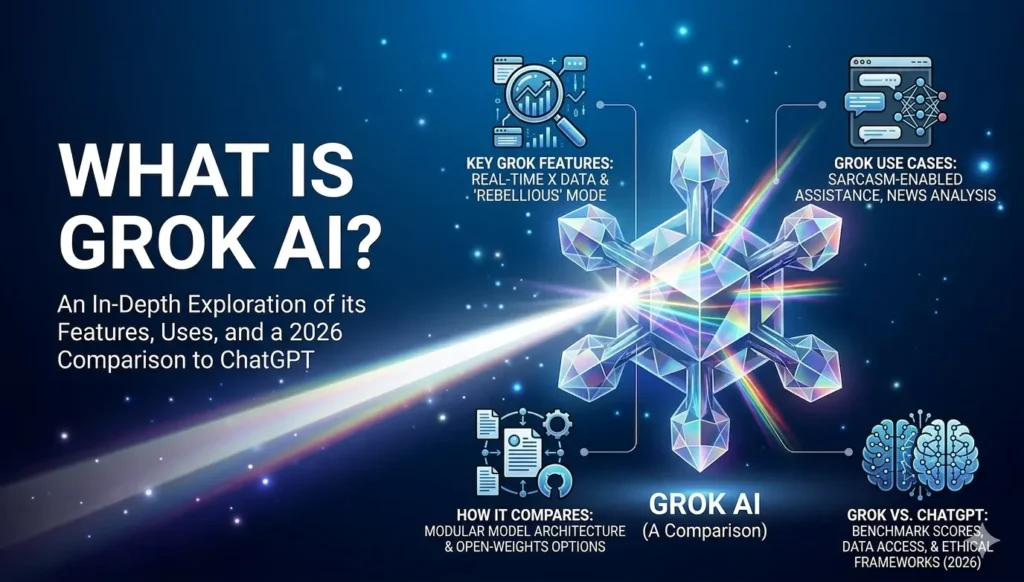
Artificial intelligence is evolving at an incredible pace, but very few AI products have generated as much curiosity as Grok AI.
Built by Elon Musk’s AI company xAI, Grok AI entered the market as a direct competitor to ChatGPT, Google Gemini, and Claude. But unlike most AI chatbots, Grok positioned itself differently from the beginning. It wasn’t just designed to answer questions. It was designed to provide real-time information, conversational intelligence, internet awareness, and a more personality-driven AI experience.
That approach immediately made people ask questions like:
- What is Grok AI?
- How does Grok AI work?
- Is Grok AI better than ChatGPT?
- Can Grok AI generate content and code?
- Is Grok AI free to use?
In 2026, Grok AI has become one of the most searched AI chatbots globally, especially among developers, marketers, creators, and businesses exploring next-generation AI tools.
This guide explains everything about Grok AI, its features, use cases, strengths, limitations, and how it compares to other AI systems in the market today.
What Is Grok AI?
Grok AI is an advanced AI chatbot developed by xAI, the artificial intelligence company founded by Elon Musk.
The chatbot is deeply integrated with X (formerly Twitter), allowing it to access real-time internet conversations, trending topics, and live information much faster than many traditional AI systems.
Unlike older AI chatbots that rely heavily on static training data, Grok AI focuses on:
- real-time awareness
- conversational responses
- internet-connected reasoning
- content generation
- coding assistance
- trend analysis
This makes Grok AI particularly useful for users who want current information rather than outdated AI-generated responses.
The term “Grok” itself comes from science fiction and means to deeply understand something intuitively. That branding reflects xAI’s broader vision of building AI systems that can reason and interact more naturally with humans.
If you’re interested in how AI systems are evolving beyond traditional chatbots, you can also explore:
Both topics connect closely with the rise of intelligent AI systems like Grok AI.
How Does Grok AI Work?
Grok AI works using large language model (LLM) technology combined with real-time internet access and conversational AI infrastructure.
Most traditional AI chatbots rely heavily on training data collected months or years ago. Grok AI takes a different approach by integrating live information directly from the web and the X platform.
This allows Grok AI to:
- analyze trending discussions
- summarize current events
- answer real-time questions
- understand online sentiment
- generate timely responses
Its architecture combines:
- natural language processing (NLP)
- machine learning
- internet retrieval systems
- conversational reasoning
- AI-generated summarization
This real-time capability is one reason Grok AI is increasingly being used for:
- market research
- SEO trend analysis
- social media insights
- content generation
- technology research
These articles naturally support the broader discussion around AI-powered information systems.
Grok AI Features in 2026
One reason Grok AI has become so popular is its wide range of features.
Unlike earlier AI assistants focused only on conversation, Grok AI now supports multiple workflows for creators, developers, marketers, and businesses.
Some of the most important Grok AI features include real-time internet access, conversational search, coding support, AI content generation, image generation capabilities, and social trend analysis.
The real-time search functionality is especially important because users increasingly expect AI systems to provide updated information instantly.
For example, Grok AI can help users:
- summarize breaking news
- analyze X trends
- generate marketing ideas
- explain technical concepts
- write content
- assist with coding tasks
- brainstorm social media strategies
This makes it more than just a chatbot. It functions more like a live AI research assistant.
Another important feature is Grok AI’s conversational tone. Unlike many robotic AI assistants, Grok was intentionally designed to sound more natural, engaging, and personality-driven.
That unique style helped Grok stand out in an increasingly crowded AI market.
Grok AI vs ChatGPT
One of the biggest searches online today is “Grok AI vs ChatGPT.”
The truth is that both systems are strong, but they focus on different strengths.
ChatGPT is currently more mature for:
- deep reasoning
- coding workflows
- structured writing
- productivity tasks
- workflow automation
Meanwhile, Grok AI stands out for:
- real-time information
- social trend awareness
- conversational interactions
- internet-connected responses
- live content discovery
For marketers and creators, Grok AI can sometimes feel more dynamic because it reflects ongoing internet conversations more effectively.
For developers and enterprise workflows, ChatGPT often remains stronger because of its broader ecosystem, integrations, memory systems, and workflow capabilities.
The competition between these AI systems reflects a larger industry trend where AI tools are becoming increasingly specialized.
If you’re exploring the future of AI search and conversational systems, you can also connect to:
- Will ChatGPT Browser Atlas Change AI Browsing?
- Everything You Need to Know About Bing AI Performance Report
These internal links strengthen semantic SEO around AI search and browser-based AI experiences.
Can Grok AI Generate Content?
Yes, Grok AI is now widely used for AI content generation.
Creators and marketers use Grok AI for:
- blog writing
- social media captions
- content ideas
- SEO brainstorming
- video scripts
- email drafts
- ad copy
Because Grok AI has access to trending discussions and real-time internet context, it can often generate more timely and culturally relevant content compared to static AI systems.
This is especially useful for:
- trend-based marketing
- viral content creation
- news commentary
- social media campaigns
However, like all AI writing systems, Grok AI still requires human editing and fact-checking. AI-generated content works best when combined with human expertise and strategic thinking.
Is Grok AI Good for Coding?
Grok AI has improved significantly in coding assistance.
Developers now use Grok AI for:
- debugging
- code explanations
- generating snippets
- learning programming concepts
- quick prototyping
However, Grok AI is still evolving compared to specialized AI coding systems.
Tools like ChatGPT Codex, Claude Code, and Devin currently provide stronger developer-focused workflows for advanced software engineering.
Still, Grok AI is becoming increasingly useful for beginner and intermediate coding tasks because of its conversational approach and simplified explanations.
This topic internally aligns well with:
Is Grok AI Free?
One of the most common searches online is “Is Grok AI free?”
Grok AI currently offers limited access depending on the platform and subscription structure connected with X Premium services.
Some features may be available freely, while advanced capabilities often require paid access.
As AI competition grows in 2026, pricing models are changing rapidly across the industry. Most companies are now balancing:
- free access
- premium subscriptions
- enterprise AI services
- API monetization
This trend is becoming common across nearly every major AI platform.
The Future of Grok AI
Grok AI represents something bigger than just another chatbot.
It reflects the broader shift toward:
- real-time AI
- internet-connected intelligence
- conversational search
- AI agents
- autonomous workflows
As AI systems continue evolving, users increasingly expect tools that can:
- understand live information
- automate tasks
- interact naturally
- reason contextually
- assist across multiple workflows
This is exactly where the AI industry is heading.
The future of AI will likely combine:
- conversational systems
- browser automation
- real-time retrieval
- workflow orchestration
- persistent AI agents
And Grok AI is positioning itself aggressively inside that future.
FAQs
What is Grok AI?
Grok AI is Elon Musk’s AI chatbot developed by xAI for real-time conversations, internet search, and AI-powered assistance.
Is Grok AI better than ChatGPT?
Grok AI is stronger for real-time internet information, while ChatGPT performs better for advanced workflows and productivity tasks.
Is Grok AI free to use?
Some Grok AI features are free, while advanced access may require an X Premium subscription.
Can Grok AI generate content?
Yes, Grok AI can create blogs, captions, marketing ideas, scripts, and AI-generated content.
Is Grok AI good for coding?
Grok AI supports coding assistance, debugging, and code explanations, especially for beginners and intermediate developers.
Key Takeaways
Real-Time Data Advantage – Grok AI integrates directly with X (Twitter), allowing it to analyze live posts, trending topics, and social conversations in real time.
Built by Elon Musk’s xAI – Developed by xAI, Grok aims to create truth-seeking AI systems designed to understand complex topics and provide deeper insights.
Powerful for Marketers and SEO Professionals – Grok can generate SEO-optimized content, analyze trends, research keywords, and help build data-driven marketing strategies.
Advanced AI Technology – Powered by large transformer-based language models, Grok supports complex reasoning, long-form content generation, coding, and research tasks.
Strong Competition to Other AI Chatbots – While ChatGPT, Gemini, and Claude lead in certain areas, Grok’s biggest advantage is its real-time social data analysis and conversational style.