Search engine optimization has always depended on one key factor: data. The more clearly businesses understand how users search, what keywords drive traffic, and how their website appears in Google Search results, the easier it becomes to build an effective digital marketing strategy. Over the years, Google has introduced several tools to help website owners analyze search performance, and Google Search Console has become one of the most important platforms for SEO professionals.
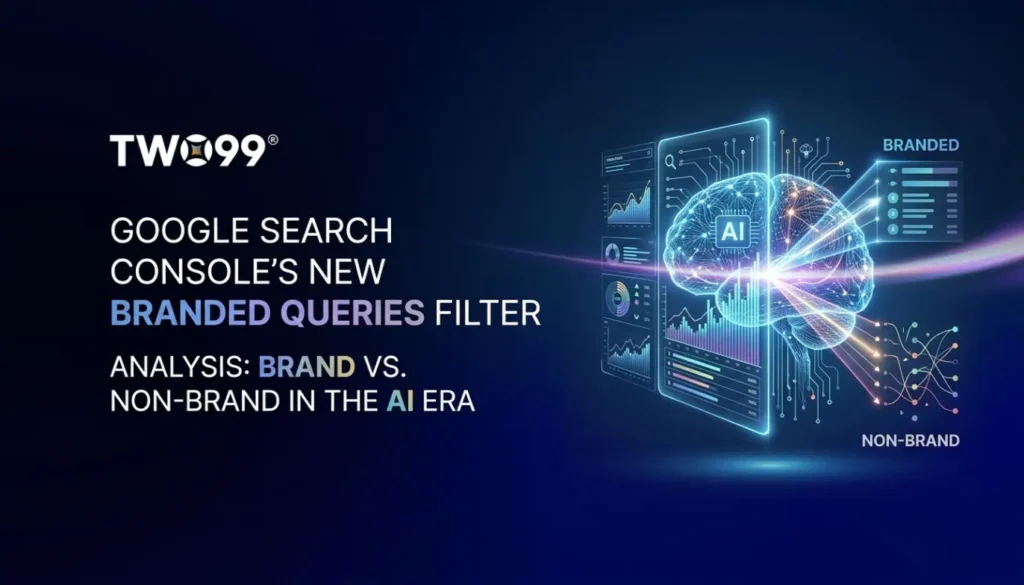
Recently, Google introduced a new feature in the Search Console Performance report called the “Branded Queries Filter.” This update is designed to help website owners easily distinguish between branded search queries and non-branded search queries. Although this may seem like a small update at first glance, it actually provides extremely valuable insights for marketers, SEO specialists, and businesses that want to understand how users discover their websites.
Before this update, separating brand-related searches from general search queries required manual filtering, spreadsheets, and sometimes complex data analysis. With the new branded queries filter, Google has made it significantly easier to analyze organic traffic and understand whether users are finding a website because they already know the brand or because they discovered it through search.
For businesses like Two99.org, this feature provides a clearer picture of how SEO and brand awareness are contributing to website growth. In this article, we will explore what branded and non-branded keywords are, why the difference matters, how the new Google Search Console update works, and how companies can use this data to improve their SEO strategies.
Understanding Branded and Non-Branded Keywords
To fully understand the impact of this update, it is important to first understand the difference between branded keywords and non-branded keywords.
Branded keywords are search queries that include the name of a company, brand, product, or a variation of the brand name. These types of searches are usually performed by users who are already familiar with the brand and are intentionally looking for that specific business, website, or service. Because the user already knows the brand, the likelihood of them clicking on the official website is much higher.
For example, if the company name is Two99, some common branded searches might include queries such as “Two99,” “Two99.org,” “Two99 digital marketing services,” “Two99 SEO agency,” or “Two99 reviews.” These queries clearly indicate that the user already knows about the brand and is trying to find information specifically related to it.
On the other hand, non-branded keywords are search queries that do not include a brand name. These searches are typically made by users who are looking for information, products, or services but have not yet chosen a specific company. For example, someone might search for “best digital marketing agency,” “SEO services for startups,” “how to improve website ranking,” or “digital marketing strategies for small businesses.” These searches are broader and often represent users who are still exploring their options.
The distinction between branded and non-branded keywords is extremely important because it helps businesses understand how users are discovering their website. Branded traffic usually indicates brand awareness, while non-branded traffic indicates the effectiveness of a website’s SEO strategy.

Why the Difference Between Branded and Non-Branded Traffic Matters
Many businesses measure their SEO success based on total organic traffic. However, looking only at overall traffic numbers can sometimes be misleading. For instance, imagine a website that receives 50,000 organic clicks every month. At first glance, this might seem like excellent SEO performance.
But when we break down the queries behind that traffic, the numbers might reveal a different story. Suppose 35,000 of those clicks come from branded searches such as “Two99” or “Two99 services,” while only 15,000 clicks come from general keywords such as “SEO services for startups.” This would mean that the majority of traffic is coming from people who already know the brand.
While strong branded traffic is a good sign of brand awareness, it does not necessarily indicate that the website is attracting new users through search engines. In contrast, if the majority of traffic comes from non-branded queries, it shows that the website is ranking well for general search topics and successfully reaching new audiences.
For this reason, many SEO professionals consider non-branded traffic to be the true indicator of SEO performance. It reflects how effectively a website is ranking for keywords that potential customers are searching for.
The Challenge SEO Professionals Faced Before This Update
Before the branded queries filter was introduced, analyzing branded and non-branded traffic in Search Console was not simple. SEO specialists often had to export search query data into spreadsheets and manually filter brand-related keywords using formulas or regular expressions.
This process involved identifying all possible variations of a brand name, including misspellings, abbreviations, and product names. For example, if a company’s brand name was Two99, the SEO team might need to filter queries such as “two99,” “two 99,” “two99.org,” “two99 agency,” or “two99 marketing services.”
Even after doing this manual filtering, it was still possible to miss some branded queries or incorrectly categorize others. For websites with thousands of search queries, this process could become extremely time-consuming.
Google recognized this challenge and introduced the branded queries filter to simplify the analysis.
What Is the Google Search Console Branded Queries Filter?
The branded queries filter is a new feature in the Search Console Performance report that automatically categorizes search queries into two groups: branded queries and non-branded queries.
With this feature, website owners can easily filter their performance data to see how many impressions, clicks, and rankings come from branded searches versus non-branded searches. This makes it much easier to evaluate both brand awareness and SEO performance.
Google uses its own algorithms and data to determine whether a search query is brand-related. The system analyzes brand names, common variations, misspellings, and other signals to identify branded searches automatically.
For example, if a user searches for “Two99 SEO services” or “Two99 digital marketing agency,” Google will likely classify those queries as branded searches. Meanwhile, searches such as “SEO services for small businesses” or “digital marketing tips” would be classified as non-branded queries.
Because this classification is automated, website owners no longer need to manually analyze thousands of search queries to identify brand traffic.
Example: Branded vs Non-Branded Keywords for Two99
To better understand how this works in practice, let’s consider a simple example related to Two99.org.
If a user searches for queries such as “Two99,” “Two99 digital marketing,” “Two99 SEO services,” or “Two99 company reviews,” these would all be considered branded searches. In each of these cases, the user already knows the brand and is specifically looking for it.
However, if someone searches for “best SEO agency in India,” “digital marketing services for startups,” “how to increase website traffic,” or “SEO optimization strategies,” these would be non-branded searches. These users may not yet know about Two99, but they might discover the company if its website ranks well for these keywords.
This distinction helps businesses understand whether their website traffic is driven by existing brand recognition or by strong search visibility.
How the New Feature Makes SEO Analysis Easier
The branded queries filter simplifies SEO analysis in several important ways.
First, it eliminates the need for manual filtering. Instead of exporting data and building complex keyword lists, SEO professionals can simply apply the branded or non-branded filter within Search Console and instantly see the results.
Second, it provides a clearer understanding of traffic sources. By separating branded and non-branded queries, businesses can identify whether their growth is coming from improved brand awareness or from better search rankings.
Third, it allows marketers to measure the impact of their campaigns more accurately. For example, if a company launches a marketing campaign and branded searches increase significantly, it indicates that more people are becoming aware of the brand.
Limitations of the Branded Queries Filter
Although this feature is very helpful, there are a few limitations to consider.
Currently, Google does not allow users to manually add or edit branded keywords. This means businesses cannot customize the list of brand terms that the filter recognizes. Instead, Google automatically determines which queries are branded.
Another limitation is that the feature may not appear for websites with very low search traffic. Google requires enough search data to accurately identify brand signals.
Additionally, the classification of branded queries only applies from the time the feature was introduced. Older Search Console data may not include this separation.
How Two99 Can Use This Data Strategically
For a company like Two99.org, the branded queries filter can provide valuable insights that help guide both SEO and marketing strategies.
One of the most important uses of this data is tracking brand awareness. If branded searches such as “Two99 SEO services” or “Two99 marketing agency” increase over time, it suggests that more people are recognizing and searching for the brand.
At the same time, analyzing non-branded queries can help identify new opportunities for growth. If users frequently search for terms such as “SEO services for startups” or “how to rank on Google,” Two99 can create detailed blog posts or guides targeting those topics.
This approach helps attract new audiences while also strengthening the brand’s authority in its industry.
The Growing Importance of Brand in SEO
The introduction of the branded queries filter also highlights a broader shift in how search engines evaluate websites. In recent years, Google has increasingly emphasized brand authority, trust, and user recognition.
Strong brands tend to receive more direct searches, higher click-through rates, and greater user trust. These signals can contribute to better search visibility over time.
For this reason, modern SEO strategies often combine traditional optimization techniques with brand-building activities such as content marketing, social media engagement, and digital PR.
Final Thoughts
Google’s new Branded Queries Filter in Search Console is a valuable update that helps businesses better understand their search performance. By automatically separating branded and non-branded queries, the feature allows marketers to clearly see where their organic traffic is coming from.
For companies like Two99.org, this update provides a powerful opportunity to measure both brand growth and SEO success. Branded searches reveal how well a brand is recognized, while non-branded searches show how effectively a website attracts new audiences through search.
By analyzing both types of queries and using the insights to guide content creation, marketing strategies, and SEO efforts, businesses can build stronger online visibility and sustainable growth in search results.
As digital marketing continues to evolve, tools that provide deeper insights into user behavior will become increasingly important. The branded queries filter is another step toward helping businesses understand their audience, strengthen their brand presence, and achieve better results in search.
1. What are branded keywords in SEO?
Branded keywords are search queries that contain the name of a specific brand, company, or product. These keywords are used by people who are already familiar with the brand and want to find information related to it. For example, if someone searches for “Two99 digital marketing services” or “Two99.org SEO agency,” these queries clearly indicate that the user already knows about the company and wants to learn more about it.
Branded keywords are important because they reflect brand awareness and trust. When users search directly for a brand name, it usually means that the brand has successfully built recognition in the market. These types of searches often have higher click-through rates because users are intentionally looking for that particular brand.
2. What are non-branded keywords?
Non-branded keywords are search queries that do not contain the name of any specific brand. These keywords are usually used by people who are looking for information, products, or services but have not yet decided which company they want to choose.
For example, searches such as “best digital marketing agency,” “SEO services for startups,” or “how to increase website traffic” are considered non-branded keywords. These searches are extremely valuable because they bring new audiences to a website. If your website ranks well for these keywords, it means that users who were previously unaware of your brand may discover your business through search results.
3. Why are non-branded keywords important for SEO growth?
Non-branded keywords are often considered the true indicator of SEO success because they represent new user discovery. When a website ranks for non-branded keywords, it means that Google recognizes the website as a relevant and authoritative source for those topics.
For example, if a digital marketing agency ranks for keywords like “SEO strategy for small businesses” or “content marketing guide,” users searching for those topics may visit the website even if they have never heard of the brand before. This helps businesses expand their reach and attract potential customers who are still researching their options.
In simple terms, branded keywords show brand demand, while non-branded keywords show SEO strength and visibility in search results.
4. What is the Google Search Console branded queries filter?
The branded queries filter is a feature introduced by Google in the Search Console Performance report that automatically separates search queries into two categories: branded queries and non-branded queries.
This feature allows website owners to analyze how much of their organic search traffic comes from users who already know their brand versus users who discovered their website through general search queries. Previously, SEO professionals had to manually analyze search queries to identify brand-related searches. Now, Google automatically performs this classification, making the analysis much easier and faster.
5. How does Google determine whether a query is branded or non-branded?
Google uses advanced algorithms and data signals to determine whether a search query is related to a specific brand. The system analyzes brand names, variations, misspellings, and other related terms to identify branded searches.
For example, if the brand name is “Two99,” Google may recognize queries such as “Two99 SEO agency,” “Two99 marketing services,” or even slightly misspelled versions of the brand name as branded searches. These signals help Google classify queries more accurately.
However, the exact method used by Google is not publicly disclosed, and the classification process is fully automated within Search Console.
6. Can website owners manually add or edit branded keywords in Search Console?
Currently, Google does not allow website owners to manually add or modify branded keywords in the branded queries filter. The classification is handled automatically by Google’s system based on its understanding of brand signals and search patterns.
While this might seem like a limitation, Google’s automated system is designed to recognize common variations and misspellings of brand names. This reduces the need for manual input and helps ensure that the classification remains consistent across all Search Console data.
7. Why is it useful to separate branded and non-branded traffic?
Separating branded and non-branded traffic provides a clearer picture of how users discover your website. Branded traffic usually represents people who already know your company, while non-branded traffic represents users who found your website through search results.
For businesses, this distinction is extremely valuable. If most of your traffic comes from branded searches, it indicates strong brand awareness. However, if your non-branded traffic is growing, it suggests that your SEO strategy is successfully attracting new audiences.
Understanding this difference helps businesses improve their marketing strategies, optimize their content, and focus on the keywords that bring new users to their website.
8. Will the branded queries filter show historical data from previous years?
In most cases, the branded queries filter applies only to data collected after the feature was introduced in Google Search Console. This means that older data may not be automatically classified into branded and non-branded categories.
For website owners, this means that accurate comparisons using this filter may only be possible from the point when the feature became available. Over time, however, the filter will accumulate more data, allowing businesses to analyze long-term trends in both branded and non-branded search traffic.
9. Why might some websites not see the branded queries filter in Search Console?
Some smaller websites may not see the branded queries filter if they do not have enough search data for Google to accurately identify brand signals. Google requires a sufficient amount of search impressions and queries to determine which searches are brand-related.
If a website receives very limited search traffic or does not yet have strong brand recognition, the filter may not appear in its Search Console account. As the website grows and receives more search data, the feature may become available.
10. How can businesses use branded query data to improve marketing strategies?
Branded query data can provide valuable insights into how users perceive and search for a company online. If branded searches increase over time, it usually indicates that the brand is gaining recognition through marketing campaigns, social media presence, or word-of-mouth recommendations.
Businesses can use this data to measure the effectiveness of their marketing strategies. For example, if a company launches a new advertising campaign and branded searches increase significantly afterward, it suggests that the campaign successfully improved brand awareness.
At the same time, analyzing non-branded queries can help identify new keyword opportunities and content ideas that attract potential customers who are still exploring their options.
Key Takeaways
New Search Console Feature – Google introduced the Branded Queries Filter to automatically separate branded and non-branded search queries in the Performance report.
Better SEO Analysis – The feature allows marketers to easily understand whether organic traffic comes from brand recognition or search visibility.
No More Manual Filtering – Previously, SEO professionals had to export data and manually filter branded keywords. The new feature automates the process.
Measure Brand Awareness – Increasing branded searches often indicates stronger brand recognition and successful marketing campaigns.
Identify SEO Growth Opportunities – Non-branded queries reveal keywords that attract new audiences, helping businesses expand organic reach and create targeted content.