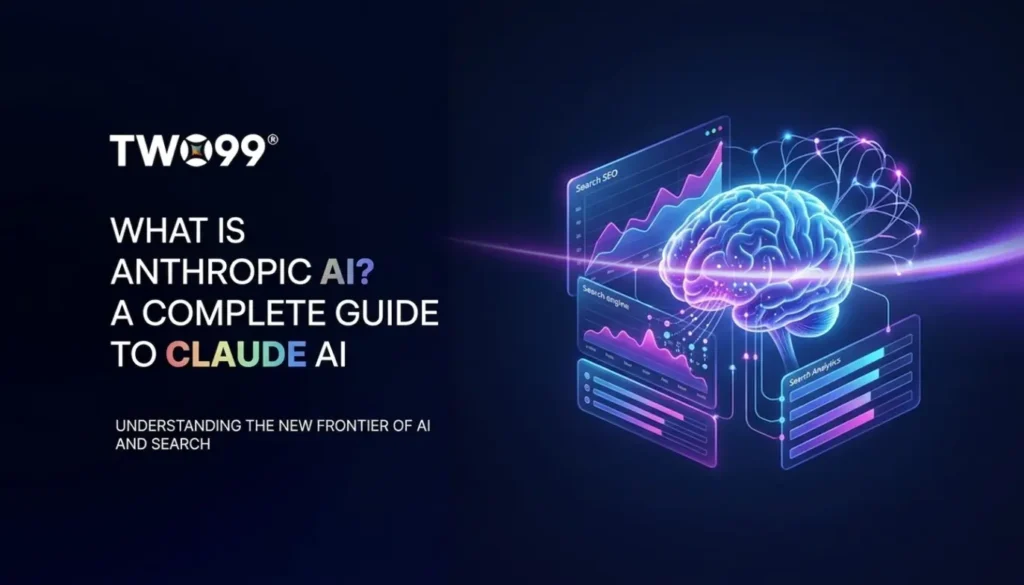
Artificial intelligence is evolving at an extraordinary pace, and new companies are emerging that are shaping how AI systems are built, deployed, and governed. One of the most influential companies in this new wave of AI development is Anthropic AI. While many organizations are focused purely on building more powerful models, Anthropic has positioned itself differently by focusing equally on capability and safety.
The company is best known for developing Claude AI, an advanced conversational assistant designed to help people write, research, code, and analyze complex information. In recent years, Anthropic has gained significant attention among developers, enterprises, and policymakers because of its strong emphasis on responsible AI development.
This guide explores everything about Anthropic AI, including how the company works, what makes Claude AI by Anthropic unique, how its models operate, how developers can integrate the platform, and why the concept of Constitutional AI is becoming central to the future of safe artificial intelligence.
What is Anthropic AI?
Anthropic AI is an artificial intelligence research and product company founded in 2021 by former OpenAI researchers. The company was created with the goal of building AI systems that are not only powerful but also reliable, interpretable, and aligned with human values.
The founders believed that as AI systems become more capable, the risks associated with them also increase. Because of this, Anthropic has placed a strong emphasis on understanding how large AI models behave and how they can be guided to produce helpful and responsible outputs.
Unlike many traditional technology companies that treat AI as just another product feature, the Anthropic AI company operates with a strong research foundation. A significant portion of the organization’s work focuses on studying AI behavior, safety mechanisms, and governance frameworks that can ensure these systems remain beneficial to society.
Over time, Anthropic has developed a growing ecosystem that includes its flagship assistant Claude, developer APIs, enterprise AI solutions, and advanced research into AI safety.

Claude AI by Anthropic
At the center of Anthropic’s technology stack is Claude AI, a conversational AI assistant designed to help users perform complex intellectual tasks.
Often referred to as Anthropic Claude AI, the system functions similarly to other AI chat assistants but places a stronger emphasis on reliability, reasoning, and safety. Claude is capable of generating long-form content, assisting with programming tasks, analyzing documents, and answering detailed questions across many domains.
One of the major advantages of Claude AI by Anthropic is its ability to work with large amounts of information at once. This makes the assistant particularly useful for researchers, analysts, developers, and organizations that need to process extensive documents or datasets.
Another key aspect of Claude’s design is its conversational behavior. The system is trained to maintain clarity and transparency in responses, often explaining reasoning rather than simply providing an answer. This helps users understand how the AI arrived at a particular conclusion, which improves trust in AI-assisted workflows.
Because of these capabilities, Anthropic’s Claude AI chatbot is increasingly being used in enterprise environments where reliability and safety are critical.
Anthropic AI Models
Behind Claude AI lies a family of advanced Anthropic AI models that power the system’s reasoning and language capabilities. These models are part of the broader Claude model series and are designed to support a wide range of tasks, from simple conversational interactions to highly complex analytical work.
The models are built with scalability in mind. They are trained to process large amounts of text while maintaining contextual understanding across long conversations or documents. This ability is often described as having a large context window, meaning the model can analyze extensive information without losing track of earlier details.
This feature is particularly important for developers and researchers who need AI systems capable of understanding full codebases, research papers, or long legal documents.
Another important element of the Anthropic AI models is their focus on structured reasoning. Instead of generating responses based purely on probability, the models are designed to produce outputs that reflect logical consistency and contextual awareness.
This makes them especially useful for applications that require deeper analytical thinking rather than simple text generation.
Anthropic AI Coding Assistant and Developer Tools
One of the fastest growing use cases for Claude is its role as an AI coding assistant. Developers increasingly rely on AI tools to write code, debug errors, and accelerate software development workflows.
Claude has gained popularity in this area because of its ability to understand complex code structures and maintain context across large programming projects. The Anthropic AI coding context window allows developers to input large portions of code, enabling the AI to analyze entire modules rather than just small snippets.
This capability significantly improves the accuracy of code suggestions and debugging assistance.
For developers who want to integrate Claude into their own applications, Anthropic provides the Anthropic AI SDK, which enables access to the models through APIs. With these tools, developers can build applications that leverage Claude’s reasoning capabilities for a wide range of tasks.
For example, companies can use the platform to build automated documentation systems, customer support assistants, or AI-driven development tools. Some development environments also integrate Claude directly into workflows through packages installed with commands such as npm install anthropic ai claude code, allowing engineers to quickly incorporate Claude into their toolchain.
The flexibility of the Anthropic AI platform makes it attractive for startups, technology companies, and enterprise teams looking to build intelligent applications.
Anthropic Claude AI Pricing
Like most AI platforms, Anthropic Claude AI pricing is structured around usage. The cost of using Claude typically depends on the model selected and the amount of data processed.
Different models within the Claude ecosystem are optimized for different types of tasks. Some models focus on speed and efficiency, while others prioritize deep reasoning and complex problem solving.
For organizations using Claude through APIs, pricing is usually calculated based on token usage. Tokens represent units of text processed by the AI system, including both the input provided by the user and the output generated by the model.
This pricing model allows companies to scale their AI usage according to their needs. Smaller applications can operate with minimal cost, while large enterprises can deploy Claude across multiple workflows and teams.
As the technology evolves and new models are introduced, Anthropic Claude AI pricing may continue to change to reflect improvements in capability and infrastructure efficiency.
Anthropic Constitutional AI and Safety Approach
One of the most distinctive aspects of Anthropic’s work is its approach to AI safety. The company has developed a framework known as Anthropic Constitutional AI, which is designed to guide AI systems toward responsible behavior.
Traditional AI training methods rely heavily on human feedback to shape how models respond. While this method can be effective, it also has limitations because human evaluators cannot review every possible scenario an AI system might encounter.
Constitutional AI introduces a different approach. Instead of relying entirely on human oversight, the model is trained using a set of guiding principles or “constitutional rules.” These rules define what types of responses are appropriate and how the AI should handle sensitive situations.
By learning to follow these principles, the AI can evaluate its own responses and adjust them to align with safety guidelines.
This approach has positioned Anthropic as one of the leading organizations in AI safety research. Many policymakers and researchers view the company’s work as an important step toward ensuring that advanced AI systems remain beneficial and controllable.
Anthropic AI News and Industry Developments
In recent years, Anthropic AI news has frequently appeared in discussions about the future of artificial intelligence.
The company has raised significant funding and formed partnerships with major technology firms. These developments have accelerated its ability to train larger models and expand its AI platform.
Anthropic researchers have also contributed to broader conversations about the societal impact of AI. For example, the Anthropic CEO has spoken publicly about AI policy and governance, emphasizing the need for global cooperation when regulating powerful AI systems.
In one widely discussed proposal, the CEO suggested the idea of an AI “quit button,” a mechanism that would allow users or authorities to immediately stop certain AI operations if necessary.
Another major topic in Anthropic AI news today involves cybersecurity concerns. Researchers have warned about the possibility of AI driven hacking campaigns linked to China, as well as broader risks related to AI orchestrated cyber espionage campaigns.
These discussions highlight how AI technology can influence both innovation and security challenges in the digital world.
Anthropic AI Controversies and Legal Discussions
As with many rapidly growing technology companies, Anthropic has also faced scrutiny and debate. Discussions around Anthropic AI class action lawsuits and potential legal frameworks for AI companies reflect the broader uncertainty surrounding the regulation of artificial intelligence.
There have also been experimental studies exploring unusual behaviors that AI systems might exhibit under specific conditions. Some media outlets have described these scenarios in dramatic ways, including references to Anthropic AI blackmail experiments, though these studies are typically designed to test how AI systems behave under extreme constraints.
These debates are part of a larger conversation about how advanced AI models should be governed as they become more powerful and widely deployed.
Anthropic AI Careers and Jobs
As the company continues to expand, interest in Anthropic AI careers has grown significantly. Professionals from many different fields are exploring opportunities to work on the development and governance of advanced AI systems.
The company hires researchers, engineers, policy experts, and product specialists who contribute to building safer and more capable AI technologies.
For many professionals, Anthropic AI jobs offer a unique opportunity to work at the intersection of cutting-edge technology and global policy discussions about the future of artificial intelligence.
The Future of Anthropic AI
Anthropic is quickly becoming one of the most influential organizations in the AI industry. Its work on Claude AI models, developer tools, and safety frameworks is shaping how artificial intelligence will evolve over the coming years.
As AI systems become more capable, the need for responsible development practices will only grow stronger. The concept of Constitutional AI may play a critical role in ensuring that advanced AI technologies remain aligned with human values and societal needs.
For developers, businesses, and researchers, understanding Anthropic AI and Claude AI is becoming increasingly important. These technologies are not only transforming how people interact with information but also redefining how intelligent systems are designed and governed.
Frequently Asked Questions About Anthropic AI
What does Anthropic AI do?
Anthropic AI is a research and technology company that develops advanced artificial intelligence systems designed to be helpful, safe, and reliable. The company focuses on building large language models that can understand and generate human-like text, assist with research, write content, analyze documents, and help developers write code.
Anthropic’s main product is Claude AI, an AI assistant capable of performing a wide range of tasks including writing, coding, reasoning, and data analysis. Beyond creating AI models, Anthropic also conducts extensive research on AI safety and alignment, exploring ways to ensure that powerful AI systems behave responsibly and remain beneficial for society.
Is Anthropic AI free?
Anthropic offers both free and paid access depending on how users interact with its AI models. Some versions of Claude AI can be accessed for free through web interfaces or limited usage plans, allowing users to try the assistant for everyday tasks such as writing, summarizing, or answering questions.
However, businesses and developers who want to integrate Claude into their applications typically use the Anthropic API, which operates on a usage-based pricing model. In these cases, organizations pay based on the amount of data processed by the AI system, often calculated through token usage. This flexible pricing allows companies to scale their AI usage according to their needs.
How is Anthropic different from ChatGPT?
Anthropic and OpenAI both build large language models, but their approaches differ in several ways. The most notable difference is Anthropic’s strong focus on AI safety and alignment research.
Anthropic developed a framework known as Constitutional AI, which trains AI systems to follow a set of guiding principles when generating responses. This approach aims to reduce harmful or misleading outputs and encourage responsible behavior from the AI.
Another difference lies in the design of Claude AI models, which are known for supporting very large context windows. This allows Claude to process long documents, complex datasets, or large codebases more effectively than many traditional AI systems.
While both Claude and ChatGPT are powerful AI assistants, Anthropic places a greater emphasis on transparency, safety research, and long-context reasoning.
Does Google own 14% of Anthropic?
Google does not fully own Anthropic, but it has made significant investments in the company. Reports have suggested that Google holds a notable minority stake in Anthropic after investing billions of dollars to support the development of its AI models.
These investments allow Anthropic to access powerful computing infrastructure while remaining an independent company. The partnership also helps integrate Anthropic’s technology into cloud services and enterprise AI platforms.
Despite these financial relationships, Anthropic continues to operate as an independent AI research organization focused on building safe and reliable artificial intelligence systems.
Who founded Anthropic AI?
Anthropic was founded by a group of former OpenAI researchers, including Dario Amodei and Daniela Amodei, along with several other AI scientists and engineers. The founders left OpenAI with the goal of building an AI company that would prioritize safety, alignment, and responsible AI development from the beginning.
Their experience in training large AI models and studying AI behavior helped shape Anthropic’s research-driven approach to artificial intelligence.
What is Claude AI used for?
Claude AI is used for a wide range of tasks that involve reasoning, writing, and analyzing information. Many individuals use Claude for everyday productivity tasks such as drafting emails, summarizing documents, generating ideas, or researching topics.
Businesses and developers often use Claude for more advanced applications, including customer support automation, coding assistance, data analysis, and knowledge management systems. Because Claude models can process large amounts of text at once, they are particularly useful for analyzing long reports, legal documents, or research papers.
Is Claude AI better for coding?
Claude AI has become popular among developers because of its ability to understand complex programming tasks and maintain context across large codebases. Its large context window allows developers to input multiple files or long sections of code, making it easier for the AI to identify patterns, detect errors, and suggest improvements.
While different AI tools may perform better in specific programming environments, many developers find Claude particularly useful for debugging, documentation generation, and explaining complicated code structures.
What is Constitutional AI?
Constitutional AI is a training method developed by Anthropic to guide how AI systems generate responses. Instead of relying solely on human feedback during training, the model learns from a set of guiding principles that act like a constitution for the AI.
These principles help the AI evaluate its own responses and ensure they align with safety standards. By following these rules, the system can avoid generating harmful or misleading content while still providing helpful and informative answers.
This approach is considered one of the major innovations in the field of AI alignment research.
What companies use Anthropic AI?
Many technology companies, startups, and enterprise organizations use Anthropic’s AI models to build intelligent applications. Claude AI is often integrated into products that require natural language understanding, such as productivity tools, customer support platforms, coding assistants, and research systems.
Anthropic also collaborates with major cloud providers and technology firms to make its AI models available to developers around the world.
Can Anthropic AI replace human work?
Anthropic AI systems are designed to assist humans rather than replace them entirely. Tools like Claude can automate repetitive tasks, analyze large datasets, and generate written content, which can significantly improve productivity.
However, human expertise remains essential for critical thinking, creativity, ethical judgment, and decision-making. In most real-world applications, AI functions as a supportive tool that enhances human capabilities rather than replacing them.
Key Takeaways
Anthropic AI is an AI research company founded by former OpenAI researchers focused on building safe and reliable AI systems.
Claude AI is the company’s main product, designed for tasks like writing, coding, research, and complex document analysis.
Anthropic models support large context windows, allowing them to process long documents, codebases, and datasets effectively.
The company provides developer tools and APIs that enable businesses to integrate Claude into applications and workflows.
Constitutional AI is Anthropic’s safety framework that trains AI systems using guiding principles to encourage responsible and aligned outputs.