AI Purchasing Agents: 4 Proven Steps to Win the Agentic Commerce Revolution
For decades, the undisputed foundation of digital marketing has been built entirely on human psychology. Brands spent trillions of dollars studying color theory to trigger visceral emotional reactions. Copywriters meticulously mapped narrative arcs to build brand affinity, while UX/UI designers engineered hyper-optimized storefronts to guide a human eye toward a flashing “Buy Now” button.But what happens when your buyer doesn’t have emotions? What happens when your customer is a piece of autonomous, self-learning code?Welcome to the era of Agentic Commerce. Driven by major industry milestones—including the widespread adoption of Google’s Universal Commerce Protocol (UCP) across AI ecosystems and OpenAI’s deep transactional integrations—the digital storefront is undergoing its most radical architectural transformation since the dawn of the internet.We are no longer just marketing to people. We are actively marketing to machines. This paradigm shift means businesses must learn how to catch the attention of AI purchasing agents long before a human ever enters the decision-making loop.
According to data from Gartner and Deloitte’s enterprise analysis, over 90% of B2B procurement and a massive share of D2C retail exchanges will be intermediated by autonomous AI agents by the end of the decade.
The Rise of the Machine Buyer
In both enterprise procurement and direct-to-consumer (D2C) retail, buyers are becoming completely hands-off. Instead of spending days scouring search engines, downloading whitepapers, comparing complex technical spec sheets, and analyzing vendor portfolios, users are delegating entire buying journeys to goal-oriented software assistants.
An enterprise executive can now simply instruct an AI agent:
“Find and procure an enterprise-grade cloud security provider that is ISO-certified, fits within a $75,000 annual budget, and seamlessly integrates with our current data architecture.”
The AI agent doesn’t look at your beautiful web design, nor does it care about your premium branding videos. It processes raw data. It breaks natural language prompts down into programmatic constraints, crawls the web using advanced Model Context Protocol (MCP) architectures, queries product catalogs, verifies compliance databases, and constructs a strict, unbiased shortlist.
Understanding this completely data-driven process is essential to scoring high with AI purchasing agents. This shift means businesses must learn how to catch the attention of AI purchasing agents before traditional marketing even comes into play.
If your enterprise isn’t optimized for machine-readability upstream, you are systematically eliminated from the candidate set before a human ever views your quote. Legacy metrics like Click-Through Rates (CTR) are giving way to a critical new KPI:AI Visibility & Citation Rate. Discover how to evaluate your current machine footprint using our specialized AI SEO Solutions.
The Architecture Mismatch: Visual Storefronts vs. Programmatic Realities
The core challenge facing modern enterprises is an architectural disconnect. Almost every existing e-commerce platform and corporate website was built around session-based human navigation. A user types a keyword, a page ranks, a human evaluates product grids, and a checkout is completed via manual credit card entries.
Agentic AI completely strips away this visual session layer. When a shopping agent or B2B procurement bot searches for a solution, evaluation happens programmatically.
If your data is nested within unstructured text blocks, trapped inside standard PDFs, or locked behind slow database loads, the AI cannot confidently parse it. The storefront may technically exist on the web, but it is functionally invisible to a machine buyer.
Understanding this data-driven process is essential to scoring high with AI purchasing agents.
| Step in the Funnel | Traditional Marketing (Human) | Agentic Commerce (Machine) |
|---|---|---|
| Intent Capture | Search queries, browsing, visual ads | Natural language parsing of constraints and goals |
| Product Discovery | Reviewing landing pages and brand copy | Automated API metadata filtering and indexing |
| Trust Evaluation | Reading testimonials, watching case studies | Cross-platform consensus scraping via MCP |
| Checkout Flow | Manual shopping cart and forms | Programmatic API calls and tokenized payments |
4 Ways to Optimize Your Brand for AI Purchasing Agents
To ensure your brand is discovered, cross-referenced, and ultimately selected by autonomous software bots, your digital infrastructure must undergo a deep technical overhaul.
Here is the four-step playbook to achieving true Generative Engine Optimization (GEO).
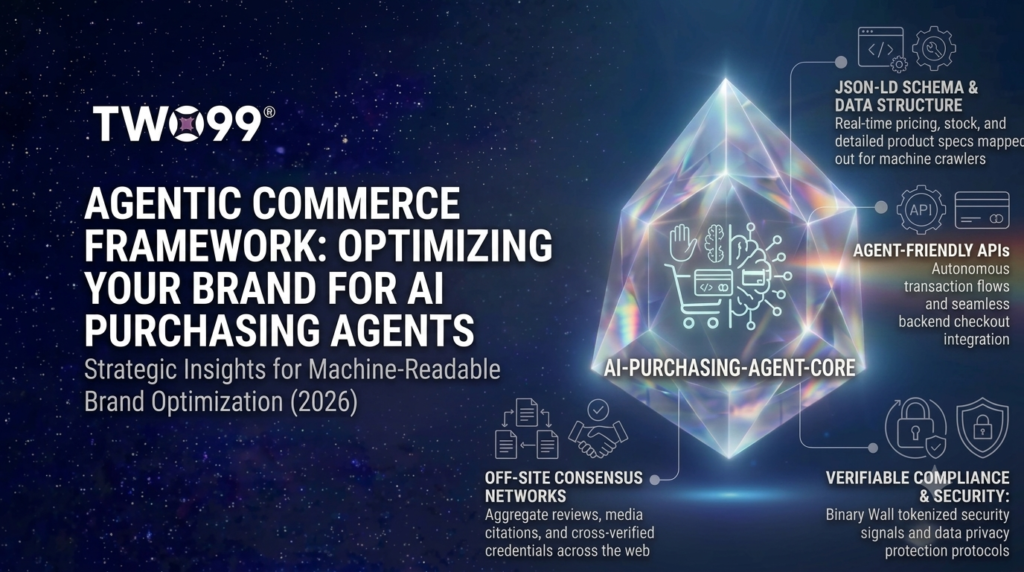
1. Implement Strict, Multi-Layered Product Schemas
AI agents devour structured data, completely ignoring marketing adjectives. If your webpage describes a product as a “revolutionary, industry-leading software suite,” a bot filters that out as noise. Instead, it seeks out cold, mathematical, and structural metadata.
Your technical infrastructure must deploy advanced, comprehensive Schema.org markup injected directly into your source code. This structured data layer must feed real-time information to web crawlers, covering your real-time economics—such as dynamic pricing models, accepted currencies, contract terms, and subscription structures.
Furthermore, you must expose granular specifications, including:
- Feature arrays
- Processing parameters
- Technical dependencies
- Standardized organizational identifiers
- Official Global Trade Item Numbers (GTIN)
- Machine-readable specifications
- Compatibility information
- Structured product metadata
When AI purchasing agents crawl your website, they prioritize structured, validated, and easily accessible information over promotional messaging. Businesses that invest in machine-readable schemas dramatically improve their visibility within autonomous procurement systems.
2. Build Off-Site “Consensus Networks”
An advanced AI purchasing agent will never take your website’s self-made claims at face value. Unlike traditional customers who may be persuaded by compelling marketing copy, AI systems are designed to verify every claim through independent sources before making recommendations or procurement decisions.
To prevent errors and minimize transactional risk, AI models execute automated cross-verification routines across the broader web. Instead of trusting a single source, they scrape multiple data points and calculate a mathematical confidence score based on consistency and authority.
Deploying a strategy that satisfies AI purchasing agents requires your brand footprint to remain consistent across third-party platforms. The agent evaluates information from numerous trusted sources before assigning credibility to your business.
These external sources often include:
- Review platforms such as G2
- Trustpilot customer ratings
- Industry-specific review portals
- Technology comparison websites
- Discussion forums
- Professional communities
- Media publications
- News websites
- Industry blogs
- Social proof across multiple channels
Beyond review platforms, AI agents actively analyze discussions occurring within specialized communities. They scan forums, Reddit discussions, developer communities, and expert blogs to identify authentic user experiences that cannot easily be manipulated.
This process creates what can be described as a “Consensus Network.” Rather than depending on a single review score, AI systems compare hundreds or even thousands of independent references to determine whether your company consistently delivers on its promises.
For example, if your website claims to provide industry-leading customer support, the AI purchasing agent will attempt to validate this statement by analyzing customer reviews, forum discussions, media mentions, and third-party reports.
If positive feedback appears consistently across authoritative sources, the AI increases your confidence score.
However, if the AI discovers contradictions between your marketing claims and external discussions, your credibility decreases significantly.
This means that businesses can no longer rely solely on polished landing pages. Brand authority now extends far beyond your own website.
Maintaining accurate business information, encouraging authentic customer reviews, publishing expert content, earning quality media coverage, and participating in industry conversations all contribute toward improving AI trust signals.
In the age of Agentic Commerce, off-site authority is becoming just as important as on-site optimization.
3. Open Up Agent-Friendly API Infrastructure
The traditional customer journey usually ends with a visitor completing a purchase through a shopping cart or contacting a sales representative.
Agentic Commerce changes this process entirely.
Instead of interacting with graphical interfaces, AI purchasing agents communicate directly with software systems through APIs.
If an AI cannot easily retrieve pricing information, inventory data, service availability, technical specifications, or compliance documentation, it encounters unnecessary friction.
Every additional obstacle increases the likelihood that the AI will simply move to another vendor whose systems are easier to access.
Modern enterprises should therefore expose secure APIs that provide structured access to essential business information.
These APIs may include:
- Product catalogs
- Pricing structures
- Subscription plans
- Inventory availability
- Shipping information
- Contract templates
- Compliance documentation
- Product specifications
- Configuration options
- Customer support resources
By providing well-documented APIs, businesses allow autonomous systems to collect information without relying on visual page rendering.
Machine-readable endpoints significantly reduce friction throughout the purchasing journey. This entire data transformation can be accelerated using custom AI Content Solutions explicitly engineered to format backend insights for language model consumption.
One increasingly important technology enabling this interaction is the Model Context Protocol (MCP).
MCP allows AI systems to securely connect with external applications while maintaining structured communication between language models and enterprise software.
Through MCP-compatible infrastructure, AI purchasing agents can:
- Check inventory availability
- Verify pricing
- Retrieve compliance certificates
- Compare vendors
- Generate procurement reports
- Initiate purchasing workflows
- Submit purchase requests
- Complete transactions
All of these operations occur without requiring a human to manually browse a website.
The faster an AI agent can retrieve reliable information from your systems, the more likely your business becomes part of the recommended vendor shortlist.
Organizations investing in API-first infrastructure today are positioning themselves for a future where machine-to-machine commerce becomes the industry standard.
4. Lock Down Advanced Security Signals
Because autonomous purchasing agents are entrusted with accessing enterprise budgets, evaluating suppliers, navigating APIs, and even executing contracts, they operate under extremely strict security and compliance requirements. Unlike human buyers who may overlook certain technical issues, AI systems perform comprehensive security assessments before recommending any organization.
Before finalizing a procurement shortlist, an AI purchasing agent automatically checks whether a company meets industry-recognized security standards. Every technical signal contributes to an overall trust score that influences purchasing decisions.
Businesses should ensure their digital infrastructure demonstrates:
- HTTPS encryption across every webpage
- SSL/TLS certificates
- ISO/IEC 27001 certification
- SOC 2 compliance
- GDPR and privacy compliance where applicable
- Secure API authentication
- Machine-readable compliance documentation
- Reliable hosting infrastructure
- Secure server configurations
- Regular vulnerability monitoring
Autonomous agents also verify whether compliance certifications are publicly accessible through trusted registries. If security documentation is outdated, missing, or difficult to validate, confidence in the business decreases significantly.
Data privacy has become another major ranking factor. Organizations handling customer information must clearly demonstrate how data is stored, encrypted, processed, and protected.
Security is no longer simply an IT responsibility—it has become a competitive marketing advantage in the age of AI-powered commerce.
The stronger your security posture appears to autonomous purchasing systems, the more likely your business will be shortlisted for enterprise procurement opportunities.
Why “Consortium” Agencies Win in the Agentic Era
The rise of machine-mediated commerce has exposed one major weakness in traditional digital marketing.
Creative agencies excel at storytelling, branding, advertising, and visual design. They know how to persuade human audiences but often lack deep technical capabilities.
Software development companies face the opposite challenge. They understand APIs, backend architecture, databases, cloud infrastructure, and automation but frequently overlook brand authority, content strategy, digital PR, and search optimization.
Winning in Agentic Commerce requires expertise across multiple disciplines simultaneously.
Modern businesses must combine:
- Technical SEO
- Schema implementation
- API development
- Data engineering
- Cybersecurity
- Cloud infrastructure
- Digital PR
- Content marketing
- Authority building
- AI optimization
This integrated approach explains why consortium-style agencies are becoming increasingly valuable. Instead of hiring disconnected vendors for marketing, development, security, and AI implementation, organizations benefit from unified teams capable of optimizing every aspect of machine-readable commerce.
When structured data, API infrastructure, authority signals, cybersecurity, and AI visibility work together, businesses become significantly easier for autonomous purchasing systems to discover, evaluate, and recommend.
Future-Proof Your Business for Agentic Commerce
The transition toward AI-driven purchasing is no longer a prediction for the distant future. It is already reshaping procurement workflows, enterprise buying decisions, and consumer commerce across industries.
Organizations that continue optimizing only for traditional search engines and human visitors risk becoming increasingly invisible to the autonomous systems responsible for tomorrow’s purchasing decisions.
The next generation of digital commerce belongs to businesses that understand both human psychology and machine intelligence.
Preparing your organization today means investing in:
- Structured product data
- Machine-readable content
- Robust API infrastructure
- Consistent third-party authority
- Verified security standards
- Technical SEO for AI systems
- Cross-platform trust signals
- Future-ready digital architecture
Businesses that embrace these strategies early will gain a substantial competitive advantage as AI purchasing agents become the default decision-makers across B2B procurement and direct-to-consumer commerce. Book a meeting with our team today or look into our Business Consultancy Solutions to audit your digital architecture for 2026 and beyond.
Frequently Asked Questions (FAQs)
-
Q: What is an AI purchasing agent?
-
An AI purchasing agent (or machine buyer) is an autonomous software assistant designed to execute end-to-end purchasing pipelines. Given strict parameters (such as budget constraints, technical specs, and features), the bot finds, validates, and completes a checkout programmatically without human friction.
-
Q: How does Agentic Commerce change legacy B2B optimization?
-
Traditional online marketing depends on visual layouts, human cognitive models, and manual navigation blocks. Agentic commerce replaces this entirely with dynamic API discovery layers, clean JSON-LD infrastructure, and verified code execution parameters.
-
Q: What is the “AI Citation Rate”?
-
As bots replace manual vendor search, legacy Click-Through Rates (CTR) are shifting to the AI Citation Rate—a technical metric calculating how effectively your brand ecosystem is scraped and cited inside an LLM’s tailored recommendation grid.
-
Q: How do companies build off-site authority for machine buyers?
-
AI agents do not trust standard promotional copies. They audit external trust networks by cross-referencing public forums (like Reddit), verified software review hubs (like G2 or Trustpilot), and authoritative press signals to establish data consensus.
Key Takeaways
-
Agentic Shift: Marketing is moving from human psychology to machine-readability as autonomous AI agents take over B2B procurement and e-commerce.
-
The New KPI: Traditional Click-Through Rates (CTR) are being replaced by the AI Citation Rate—the frequency with which bots recommend your brand.
-
Structured Schema: Websites must deploy clean, real-time data data frameworks so AI crawlers can instantly read pricing and product inventory.
-
Open APIs: Brands must offer robust, accessible backend API endpoints to allow software assistants to execute transactions programmatically.
-
Off-Site Consensus: AI engines validate claims by cross-referencing third-party nodes like public forums, media coverage, and aggregate reviews.
-
Airtight Security: Risk-averse purchasing bots run automated sweeps, requiring flawless encryption and compliance signals to pass their filters.