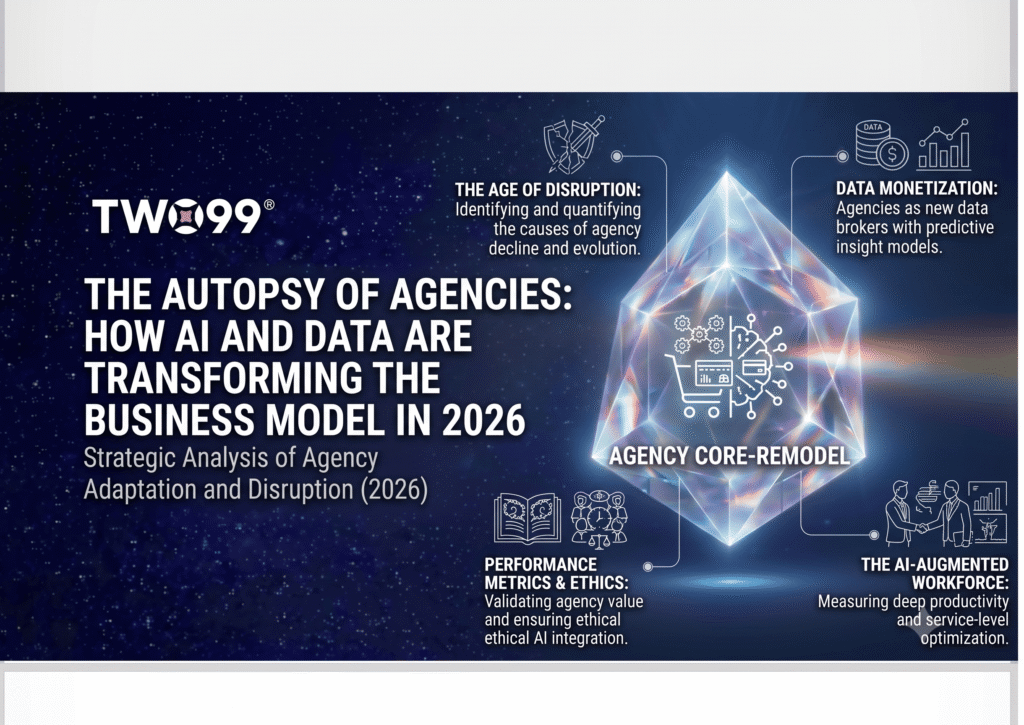
The Core Diagnostics: Three Fatal Vulnerabilities
To understand why traditional shops are filing for insolvency, we must look at where their financial pipelines are leaking.
1. The Death of the Billable Hour
For half a century, the digital marketing agency model made fortunes on a basic labor equation: hire brilliant young talent, pay them a fixed salary, and bill their time to enterprise brands at a 3x or 4x markup.
Automation completely vaporized that margin.
When a routine execution task—like building 40 localized ad variations or running basic search optimizations—historically took a team of junior staff 20 hours to complete, the agency billed for 20 hours. Today, AI-native engines accomplish that exact task with greater precision in less than two minutes.
Corporate clients are hyper-aware of this operational shift. They refuse to finance an agency’s internal overhead and inefficiencies. When a business model relies on charging a premium for raw human hours rather than proprietary outcomes, structural insolvency is inevitable.
2. The Retainer Death Spiral
The baseline financial health of old-school agencies relied on the recurring monthly retainer. Brands paid fixed monthly fees to keep an agency on standby to hit basic production quotas (e.g., publishing a set number of social posts, writing standard copy, managing ad accounts).
In today’s corporate climate, CFOs have taken control of the marketing dollar. General “brand presence” and vanity metrics no longer protect an agency during budget cuts.
When an agency focuses on output volume rather than direct economic outcomes—like lowering Customer Acquisition Cost (CAC) or maximizing Lifetime Value (LTV)—the client walks away. High client churn, paired with the massive cost of continuously pitching to replace lost revenue, creates an unsustainable balance sheet.
3. The Specialization Gap and In-Housing
As modern advertising platforms built automated media-buying features and simplified creative tools, enterprise brands realized they could bring routine content production and simple ad buying completely in-house.
What did they leave for external partners? The exceptionally complex, high-risk systems: advanced data-layer personalization, multi-channel e-commerce architectures, predictive AI modeling, and enterprise-grade cybersecurity. Traditional agencies that failed to evolve into deep technical specialists found themselves with nothing unique left to sell.
The Paradigm Shift: From Legacy Shop to Solution Consortium
The extinction of the legacy creative shop marks the rise of a lean, highly integrated breed of partner: The Solution Consortium.
Survival in the modern landscape requires rewriting the entire organizational chart. Winning requires looking less like a room of copywriters and more like a high-velocity technology, data, and security consultancy.
| Dimension | The Dead Agency Model | The Modern Solution Consortium |
|---|---|---|
| Monetization | Selling billable human hours and overhead | Selling proprietary technology, systems, and economic outcomes |
| Operational Core | Manual execution by multi-layered internal teams | Automated execution layers paired with senior strategic minds |
| Scope of Work | Isolated creative assets and basic media buying | Fully converged systems: Marketing Tech + Advanced AI + Security |
| Speed to Market | Multi-week feedback loops and rigid hierarchies | Near real-time execution driven by agile specialist nodes |
The Blueprint for the Future: The Three Pillars of Two99
To build an organization capable of scaling past these systemic industry bankruptcies, a technical partner must be engineered around three foundational truths:
1. AI-Native Infrastructure
Firms can no longer treat artificial intelligence as a simple writing assistant or casual plug-in. AI must be baked directly into the data core. By utilizing proprietary machine-learning algorithms like our internal Beetle data engine, the heavy lifting of audience segmentation, trend prediction, and asset variations happens at the speed of light. This allows senior human intelligence to focus entirely on high-level market positioning and commercial strategy.
2. Total Convergence: Tech, Marketing, and Security
Modern B2B tech marketing is no longer just a beautiful ad campaign; it is a highly integrated digital pipeline.
If a brand launches a hyper-targeted influencer campaign that drives a 500% spike in traffic to an e-commerce storefront, but the platform suffers an unoptimized checkout flow or a sudden security vulnerability, the marketing capital is entirely wasted. True growth requires a unified front: combining advanced e-commerce optimization, deep data analytics, and rock-solid defense protocols like our Binary Wall systems to protect customer data and trust at every touchpoint.
3. Concentration Over Bloat (The Specialist Network)
The era of paying premium retainers to finance a massive agency’s expensive downtown real estate and endless layers of middle management is officially over.
When a brand hires a giant, legacy agency, they assume they are buying elite quality. In reality, they are buying a hierarchy. The senior experts pitch the account, but the actual daily execution is handed down to junior staff or interns. The quality gets diluted through endless approval chains, meetings about meetings, and corporate telephone games.
True quality comes from concentration, not size. A single, tightly concentrated team of senior experts working with AI automation can deliver a level of creative and technical precision that a 500-person agency simply cannot match. You completely bypass the corporate friction, getting pure elite execution directly from the people who actually build the systems.
Stop Financing Your Agency’s Overhead
If you suspect you are paying premium retainers for manual execution that should be automated, your pipeline is leaking valuable capital. Let’s look at your systems.
We provide enterprise brands with an integrated, high-velocity alternative to the broken agency model. Get in touch with our consulting team today to schedule a comprehensive digital infrastructure and security audit.