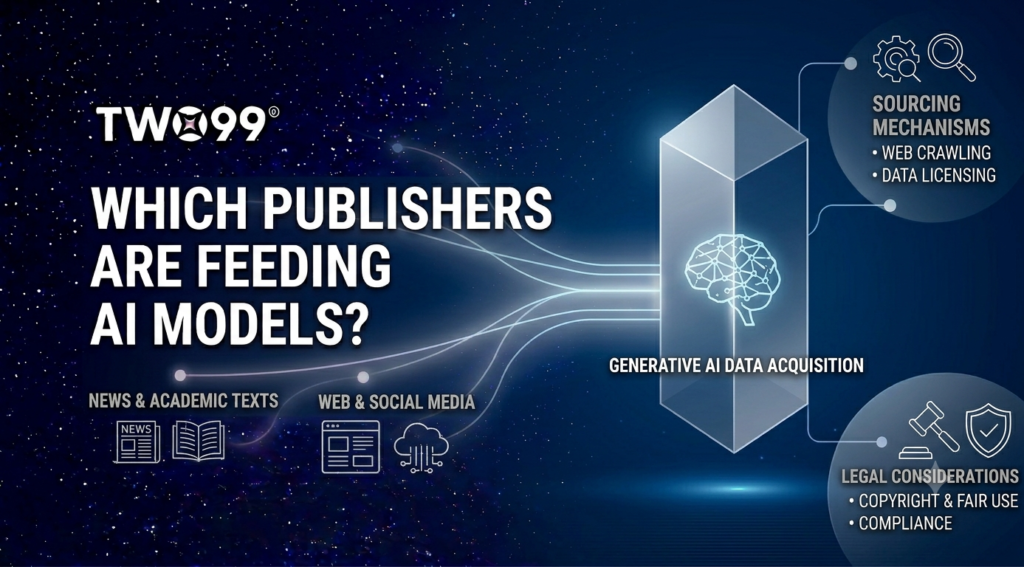
Major publishers are signing licensing deals with AI companies, granting platforms like ChatGPT, Gemini, Copilot, and Meta AI access to news content for training and real-time citation. Understanding which publishers are feeding AI models reveals the emerging power dynamics shaping digital content distribution.
The Global AI Licensing Market
The AI content licensing market reached an estimated $816 million in 2024 across 34 reported deals, with total commitments of $2.92 billion due to multi-year agreements. The average deal size was approximately $24 million, with an average term of 3.5 years.
OpenAI has been the most active buyer, accounting for 53% of deals, followed by Google and Gemini at 12%, Microsoft at 9%, and Meta at 6%. Notable agreements include News Corp’s deal with OpenAI, reportedly worth over $250 million over five years, and a separate agreement with Meta valued at up to $50 million per year for three years.
In India, OpenAI signed partnerships with Bennett, Coleman and Co Ltd and the Indian Express Group, estimated at approximately $5 million and $3 million annually respectively.
Which Publishers Have Signed Deals with Each AI Platform
OpenAI and ChatGPT Partnerships
OpenAI has secured 18 licensing deals as of October 2026. Global partners include Axel Springer (reportedly $30 million annually), Financial Times ($10 million annually), Associated Press, Hearst, Condé Nast, Le Monde, Prisa Media, Vox Media, Dotdash Meredith, TIME, Future, GEDI, Guardian Media Group, and Village Media.
These partnerships represent the premium tier of publishers feeding AI models, where content providers receive both compensation and preferential citation treatment. The Financial Times deal includes historical archive access and real-time content integration, allowing ChatGPT to cite breaking news within hours of publication.
In India, both Bennett, Coleman and Co and the Indian Express Group provide access to English and Indian-language publications, setting precedents for valuation and terms that other regional publishers now use as benchmarks.
Google Gemini and AI Overviews
Google’s News AI pilot programme includes more than 400 publications globally as of October 2026. Named partners include Axios, CNN, The Financial Times, Forbes, The Guardian, The Washington Post, Associated Press, Reach, Der Spiegel, Estadão, Folha de S.Paulo, El País, Infobae, and Antara.
Google’s approach emphasizes integration with existing search infrastructure. Publishers in the News AI pilot receive preferential placement in AI Overviews and access to analytics showing how their content performs in AI-generated summaries.
Microsoft Copilot Agreements
Microsoft has integrated OpenAI-powered Copilot into Bing and Microsoft 365. Content licensing deals include Reuters, Axel Springer, Hearst Magazines, USA Today Network, Financial Times, Condé Nast, Business Insider, and Australian publisher Nine.
Microsoft’s strategy uses its existing enterprise relationships, positioning Copilot as a productivity tool that requires high-quality, authoritative content.
Meta AI Partnerships
Meta has signed agreements with Reuters, CNN, Fox News, Fox Sports, People Inc., and USA TODAY Co., Inc. The News Corp agreement with Meta, worth up to $50 million per year for three years, allows Meta AI tools to use content from US and UK titles.
Meta’s licensing approach focuses on real-time news integration for its AI assistant across Facebook, Instagram, and WhatsApp, creating a news distribution channel that competes directly with traditional social media sharing.
Perplexity and Other Platforms
Perplexity operates a “Publishers’ Program” with revenue-sharing agreements, including TIME, Lee Enterprises, Der Spiegel, Fortune, Entrepreneur, Le Monde, and Gannett. Perplexity’s model offers a percentage of advertising revenue generated from queries that cite partner content.
Amazon has signed deals with Associated Press, The New York Times (reportedly $20 million to $25 million per year), Condé Nast, Hearst, Forbes, Reach, and Business Insider for Alexa+.
Why Licensing Deals Aren’t Driving Traffic
Despite these partnerships, publishers are seeing sharp drops in referral traffic. A TollBit study found that news sites and blogs received 96% less referral traffic from AI search engines compared to traditional Google Search.
Research from Brookings shows that publishers with direct AI licensing agreements initially enjoyed a click-through advantage, but by Q4 2025, that “deal premium” had evaporated amid a six-fold collapse in click-through rates.
A Bain & Company survey found that 80% of consumers rely on AI-generated summaries without clicking through at least 40% of the time.
| AI Platform | Average Referral Traffic vs Traditional Search | Primary Use Case |
|---|---|---|
| ChatGPT | 95.7% lower | Conversational answers, research |
| Perplexity | 95.7% lower | Real-time search synthesis |
| Google AI Overviews | Declining | Direct answer summaries |
| Microsoft Copilot | 95.7% lower | Integrated search and productivity |
Legal Battles in India
The Digital News Publishers Association (DNPA) in India, representing around 20 news companies, joined a lawsuit against OpenAI in January 2025, arguing that OpenAI’s “wilful scraping” poses a “clear and present danger to valuable copyrights.”
The Delhi High Court declined an interim injunction in July 2026, determining that storing articles to train large language models falls within research and private use exceptions under Section 52(1)(a) of the Copyright Act. However, the court confirmed jurisdiction over cross-border AI copyright disputes.
More than 30% of leading Indian news publishers have blocked OpenAI’s crawlers. Globally, The New York Times is suing OpenAI for billions. As of May 2025, there have been nine copyright infringement lawsuits against OpenAI.
The Economic Reality
Publisher licensing currently contributes only 0.5% to 2% to AI company revenues globally. For most AI companies, licensing represents a marginal cost, while for publishers, these deals offer access to audiences and revenue but do not offset traffic losses.
Research shows that the marginal contribution of any one publisher to training large language models is tiny, creating a collective action problem where individual publishers have little negotiating power. The concentration of licensing deals among major publishers creates a “winner-take-most” dynamic that threatens local and independent journalism.
How Brands Can Optimise for AI Visibility Without Licensing Deals
For brands outside the licensing elite, Generative Engine Optimisation becomes essential. Two99’s GenShark AI provides AI Search Optimisation and LLM Visibility tracking across ChatGPT, Gemini, Perplexity, and Copilot without requiring direct platform deals.
GenShark AI includes Competitor Visibility Tracking, Brand Mention Tracking, and Share of Model Tracking to measure citation frequency and accuracy. These analytics reveal which content formats, topics, and structures generate the most AI citations.
Two99’s Generative Engine Optimisation combines Conversational Content Optimisation, Entity Optimisation, and AI Citation Optimisation to improve how brands are discovered and recommended. Entity Optimisation ensures that AI models correctly understand and represent your brand, products, and expertise.
For enterprises running Advanced SEO or Enterprise SEO, Two99 integrates traditional search optimisation with AI-native discovery. Two99’s AI Ecommerce Solutions help structure product data so AI systems can discover and recommend products in AI-powered shopping experiences.
Emerging Regulations
The European Union’s AI Act requires general-purpose AI model providers to provide a summary of their training datasets and implement policies allowing rights holders to opt out. In France, Google was fined €250 million for failing to notify publishers about scraping their work.
In India, the Department for Promotion of Industry and Internal Trade is proposing a “One Nation One License One Payment” hybrid licensing model offering AI developers a mandatory blanket licence while creators receive statutory royalties. Royalties would be linked to a share of the AI system’s revenue.
The UK government favours an “opt-out” model for AI training on copyrighted works. Policymakers are exploring statutory licensing frameworks, collective licensing, mandatory transparency, and attribution systems.
Frequently Asked Questions
Can I track if my content is being used to train AI models?
Check server logs for AI crawler user agents and review your robots.txt file. GenShark AI provides Brand Mention Tracking across ChatGPT, Gemini, Perplexity, and Copilot.
Can I improve my brand’s AI visibility without a licensing deal?
Yes. Two99’s GenShark AI helps brands improve AI visibility through Entity Optimisation and Conversational Content Optimisation without a direct platform deal.
Do I need both traditional SEO and AI optimisation?
Yes. Traditional SEO drives clicks, while Generative Engine Optimisation ensures your brand is cited accurately in AI answers where 80% of users don’t click through.
Which AI platform should my brand prioritise?
ChatGPT has the largest user base. Gemini is integrated into Google Search. GenShark AI tracks performance across all platforms to inform your priority.
Taking Control of Your AI Visibility Strategy
While major publishers negotiate licensing deals, most brands face a different challenge: their content trains AI models without compensation, yet their future discoverability depends on how these models cite them. If your brand’s content is feeding AI models but you’re not seeing the visibility return, Two99’s GenShark AI helps you track, optimise, and improve how your brand appears in ChatGPT, Gemini, Copilot, and Perplexity.
Key Takeaways
-
Market Scale & Dominance: The AI content licensing market hit ~$816M in 2024 ($2.92B in commitments). OpenAI dominates with 53% of all licensing deals, followed by Google (12%), Microsoft (9%), and Meta (6%).
-
Major Publisher Deals: High-profile agreements include News Corp ($250M+ over 5 years with OpenAI; up to $50M/yr with Meta), Axel Springer ($30M/yr with OpenAI), and Financial Times ($10M/yr with OpenAI).
-
Traffic vs. Licensing Disconnect: Licensing deals do not prevent traffic loss—AI search referral traffic is down ~96% compared to traditional Google Search, as 80% of users rely on AI summaries without clicking through.
-
Legal & Regional Impact: In India, publishers like Bennett, Coleman & Co. signed ~$5M/yr deals, while the DNPA challenged OpenAI’s web scraping in court. Meanwhile, regulatory frameworks like India’s proposed “One Nation One License” model and the EU AI Act are reshaping legal compliance.
-
Strategic Alternative (GEO): Non-publisher brands must rely on Generative Engine Optimization (GEO)—utilizing strategies like Entity Optimization and tools like Two99’s GenShark AI—to maintain brand visibility and citation accuracy across LLMs.