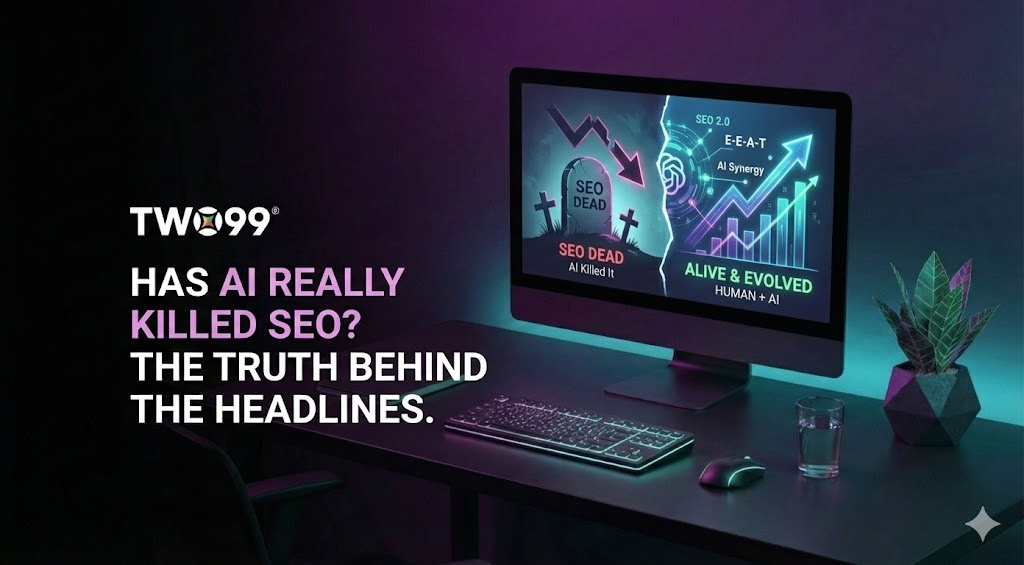
“SEO is dead” is not a new headline. Every major shift in search-from mobile-first indexing to voice search to zero-click results-has sparked the same declaration. Artificial intelligence is simply the latest trigger. As generative AI reshapes how people discover information, the question has resurfaced with renewed urgency:
Has AI really killed SEO?
The short answer is no. The longer, more important answer is that AI has changed SEO-but not in the way the headlines suggest.
SEO is not disappearing. It is evolving. And understanding how AI is changing SEO is the difference between reacting to noise and building sustainable visibility.
This article examines the myths, realities, and the future of SEO with AI-without panic, and without nostalgia.
Why People Think AI Has Killed SEO
The belief that AI has killed SEO is rooted in visible surface changes.
Users are increasingly:
- Asking questions directly to AI assistants
- Receiving summarized answers instead of lists of links
- Making decisions without clicking through multiple websites
At the same time, AI-generated content has flooded the web, blurring the line between original insight and automated text.
From the outside, it looks like:
- Fewer clicks
- Less traffic
- Less control
This has led to a simple-but incorrect-conclusion: SEO no longer works.
In reality, what’s breaking isn’t SEO itself.
It’s an outdated mental model of how SEO works.

SEO Was Never Just About Rankings
To understand why AI hasn’t killed SEO, we need to be honest about what SEO actually is.
SEO was never fundamentally about keywords or rankings. Those were mechanisms, not the purpose.
At its core, SEO has always been about:
- Helping systems understand content
- Matching information to intent
- Establishing relevance and trust
AI doesn’t eliminate these needs. It intensifies them.
The difference is that AI systems don’t just index content. They interpret, synthesize, and evaluate it. That shifts the focus from mechanical optimization to semantic clarity.
This is not the death of SEO. It’s a re-centering of SEO around understanding.
How AI Is Changing SEO (For Real)
To understand the future of SEO with AI, it’s important to separate structural change from existential threat.
Here’s what has actually changed.
1. SEO Is Moving From Pages to Meaning
Traditional SEO optimized individual pages for specific keywords.
AI evaluates:
- Concepts
- Relationships
- Context across multiple sources
This means SEO now operates at the brand and system level, not just the page level.
If your site ranks but your positioning is unclear, AI struggles to recommend you.
If your messaging is consistent and well-explained, AI can surface you even without perfect rankings.
SEO still works-but meaning now outranks mechanics.
2. Visibility Is No Longer Guaranteed by Rankings Alone
In AI-mediated discovery, ranking #1 doesn’t guarantee selection.
AI systems:
- Compare multiple options
- Synthesize pros and cons
- Choose what best fits the user’s intent
This means SEO success is no longer just about being seen-it’s about being chosen.
That’s a shift from visibility SEO to decision SEO.
3. Content Volume Matters Less Than Content Clarity
AI has made one thing very clear: more content does not equal better SEO.
AI models are overwhelmed by repetitive, shallow pages. They reward:
- Clear explanations
- Depth over breadth
- Consistency across narratives
This is why many sites publishing aggressively with AI-written content see diminishing returns.
SEO still works-but only when content adds clarity, not noise.
SEO Myths About AI (That Need to Die)
The idea that AI has killed SEO is sustained by a few persistent myths.
Myth 1: “AI Answers Mean No One Clicks Anymore”
Clicks may be fewer, but intent is higher.
Users who do click after interacting with AI are:
- More informed
- Closer to decisions
- More likely to convert
SEO is no longer about maximizing raw traffic. It’s about earning the right traffic.
Myth 2: “AI Content Ranks Better Than Human Content”
AI-generated content can rank-but only when it adds value and clarity.
Search systems increasingly penalize:
- Redundancy
- Generic phrasing
- Surface-level summaries
Human insight, original explanation, and strategic framing are becoming more valuable, not less.
Myth 3: “SEO Is Dead, So We Should Focus Only on AI Tools”
Tools don’t replace strategy.
AI has raised the bar for understanding, not eliminated the need for it. Without clear positioning and intent alignment, tools only optimize confusion faster.
Still, SEO Is Working-Just Differently
Despite the noise, the evidence is clear: SEO is still working.
But it’s working for brands that:
- Explain what they do clearly
- Maintain consistent narratives
- Structure content for understanding
- Think beyond keyword checklists
SEO today rewards:
- Authority through explanation
- Trust through consistency
- Relevance through intent alignment
These were always SEO principles. AI has simply removed the shortcuts.
The Future of SEO With AI
The future of SEO with AI is not about fighting AI systems. It’s about aligning with how they think.
That future looks like:
- Fewer pages, better explained
- Less keyword obsession, more semantic coherence
- Stronger emphasis on brand-level clarity
- SEO integrated with content, product, and positioning strategy
SEO becomes less of a channel and more of a lens-a way of ensuring your brand makes sense to intelligent systems.
Where Strategy Matters More Than Tactics
One of the biggest mistakes brands make right now is treating AI-driven SEO as a technical upgrade.
The real challenge is interpretive:
- How does AI understand us?
- Where is that understanding incomplete?
- What signals are contradictory or weak?
This is where strategy-led approaches become critical.
Teams working with AI-first strategy partners like Two99 focus less on chasing algorithm changes and more on eliminating ambiguity across content systems. By aligning SEO, content, and positioning, brands improve not just rankings-but AI-driven selection and trust.
In an AI-shaped ecosystem, SEO without strategy creates noise. SEO with strategy creates relevance.
So, Has AI Killed SEO?
No.
What AI has killed is:
- Shortcut SEO
- Mechanical optimization
- Content written for algorithms instead of understanding
What AI has strengthened is:
- Strategic SEO
- Meaning-driven optimization
- Brands that are easy to explain, compare, and trust
SEO isn’t dead.
It’s becoming more honest.
Frequently Asked Questions About AI and SEO
1. Has AI really killed SEO?
No. AI has not killed SEO-it has changed how SEO works. Traditional, shortcut-driven SEO has lost effectiveness, but strategic SEO focused on clarity, intent, and trust is more important than ever. SEO is still working, just at a deeper level of interpretation.
2. How is AI changing SEO in practice?
AI is shifting SEO from keyword-focused ranking to meaning-based evaluation. Instead of just indexing pages, AI systems interpret content, compare brands, and recommend the best option. This means SEO now prioritizes semantic clarity, consistent positioning, and strong intent alignment.
3. Is SEO still worth investing in with AI search growing?
Yes. SEO remains one of the most valuable long-term growth channels. However, the investment must evolve-from chasing rankings to ensuring AI systems can clearly understand and trust your brand. SEO that adapts to AI-driven discovery delivers higher-quality, more decision-ready traffic.
4. What SEO myths about AI should businesses ignore?
Common myths include:
- “AI answers mean no one clicks anymore”
- “AI-generated content automatically ranks better”
- “SEO is obsolete now that AI exists”
In reality, AI increases the value of clear, authoritative, and well-structured content—and penalizes shallow or confusing content.
5. What does the future of SEO with AI look like?
The future of SEO with AI is more strategic and less mechanical. It will focus on fewer but better pages, stronger brand narratives, and content designed for understanding—not manipulation. SEO will become tightly integrated with brand strategy, content systems, and AI interpretation frameworks.
Final Thought: SEO Isn’t Dying-It’s Growing Up
Every time search evolves, SEO sheds what no longer works and returns to first principles.
AI hasn’t killed SEO.
It has forced SEO to grow up.
In a world where AI mediates discovery and decisions, SEO is no longer about gaming systems. It’s about making sense-to machines and to people.
Brands that embrace this shift-often with guidance from AI-first strategy frameworks like those emphasized by Two99-will find that SEO doesn’t disappear in the AI era.
It becomes more powerful, more selective, and far more strategic.
And that’s not the end of SEO.
That’s its next chapter.
Key Takeaways
SEO is evolving, not dying, due to AI.
AI prioritizes semantic clarity, brand positioning, and content relevance over keywords.
SEO success is now about being chosen, not just being visible.
AI rewards clear, original, and in-depth content over shallow, repetitive pages.
Strategic SEO is more important than mechanical optimization.
The future of SEO with AI is focused on content clarity and brand-level coherence.