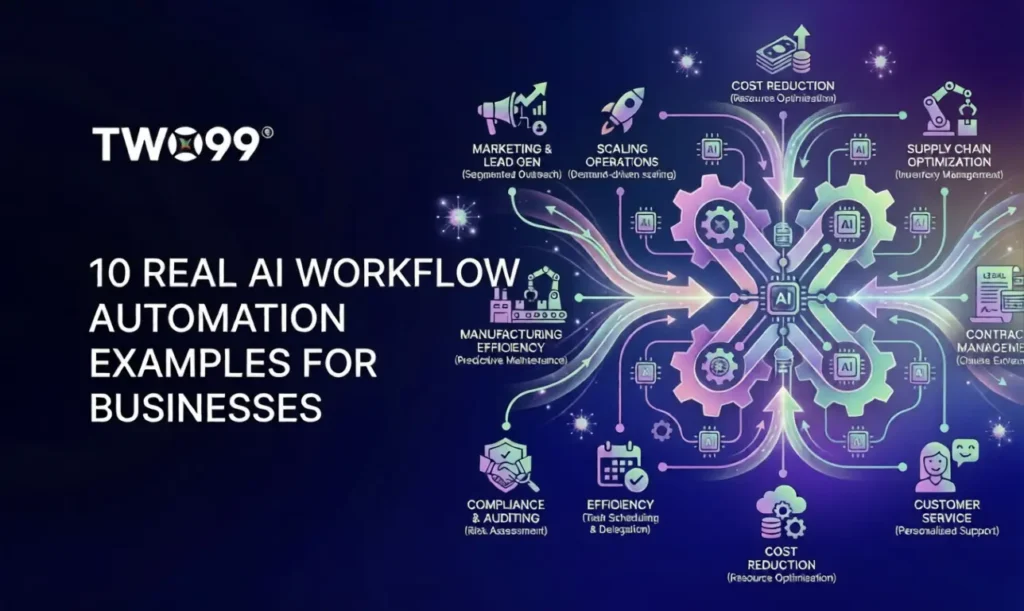
AI workflow automation is no longer a futuristic concept; it’s actively reshaping how businesses operate, scale, and compete. From small startups to large enterprises, organizations are adopting intelligent automation to streamline repetitive tasks, reduce errors, and improve productivity. If you’re exploring practical ways to implement it, these AI Workflow Automation Examples for Businesses will give you a clear picture of what’s possible today.
1. Customer Support Automation with AI Chatbots
AI-powered chatbots are one of the most common examples of automation in the workplace. Businesses use them to handle customer inquiries 24/7 without human intervention.
How it works:
- AI chatbots use natural language processing (NLP) to understand queries
- They provide instant responses or escalate complex issues
- Integration with CRM systems ensures personalized support
Benefits:
- Reduced response time
- Lower support costs
- Improved customer satisfaction

2. Automated Email Marketing Campaigns
AI tools can analyze customer behavior and trigger personalized email campaigns automatically.
Key features:
- Behavior-based triggers (cart abandonment, sign-ups)
- Personalized subject lines and content
- Optimal send-time prediction
Why it matters: This is one of the most effective AI Workflow Automation Examples for Businesses because it boosts engagement while reducing manual effort.
3. Intelligent Document Processing
Handling large volumes of documents manually is inefficient. AI automates data extraction from invoices, contracts, and forms.
Capabilities include:
- Optical Character Recognition (OCR)
- Data classification and tagging
- Automatic data entry into systems
Impact:
- Faster processing times
- Reduced human error
- Better compliance and record-keeping
4. HR Recruitment Automation
Hiring can be time-consuming, but AI simplifies the process by automating candidate screening.
What AI does:
- Scans resumes and ranks candidates
- Schedules interviews automatically
- Conducts initial chatbot-based interviews
Advantages:
- Saves HR teams hours of manual work
- Ensures unbiased candidate evaluation
- Speeds up hiring cycles
5. Sales Lead Scoring and Management
AI helps sales teams focus on high-value prospects by automatically scoring leads.
How it works:
- Analyzes customer behavior and engagement
- Assigns scores based on the likelihood of converting
- Triggers follow-ups automatically
Results:
- Increased conversion rates
- Better resource allocation
- Shorter sales cycles
6. Inventory and Supply Chain Automation
AI-driven systems can predict demand and automate inventory management.
Core functions:
- Demand forecasting using historical data
- Automatic stock replenishment
- Supplier performance analysis
Why it’s powerful: This is one of the most impactful examples of automation in the workplace, especially for retail and manufacturing businesses.
7. Financial Process Automation
Finance departments use AI to automate tasks like invoicing, expense tracking, and fraud detection.
Key applications:
- Automated invoice generation and processing
- Expense categorization
- Real-time fraud detection using pattern recognition
Benefits:
- Increased accuracy
- Faster financial reporting
- Reduced operational costs
8. Social Media Management Automation
AI tools can manage and optimize social media workflows.
Features include:
- Automated post scheduling
- Content recommendations based on trends
- Performance analytics and reporting
Outcome:
- Consistent online presence
- Improved engagement rates
- Time savings for marketing teams
9. IT Support and Helpdesk Automation
AI is transforming IT operations by automating routine support tasks.
Examples:
- Automated ticket routing and prioritization
- Self-healing systems that resolve common issues
- AI-powered virtual assistants for employees
Impact:
- Reduced downtime
- Faster issue resolution
- Lower IT workload
10. Workflow Automation in Project Management
AI tools streamline project workflows by automating task assignments and tracking progress.
Key capabilities:
- Automatic task allocation based on team capacity
- Deadline predictions and risk alerts
- Progress tracking with real-time updates
Why it matters: This is among the most practical AI Workflow Automation Examples for Businesses, as it enhances collaboration and ensures projects stay on track.
Additional Insights on AI Workflow Automation
Beyond these examples, businesses are increasingly integrating AI into everyday operations to create smarter and more adaptive workflows. For instance, AI can analyze employee performance patterns to recommend productivity improvements or automate internal communication processes. It can also assist in decision-making by providing real-time insights derived from large datasets.
Another growing trend is the use of AI in compliance and risk management. Automated systems can continuously monitor activities, flag unusual behavior, and ensure that businesses meet regulatory requirements without manual intervention. This not only reduces risk but also saves significant time and resources.
Final Thoughts
The adoption of AI in business workflows is accelerating, and for good reason. These examples of automation in the workplace show how organizations can eliminate repetitive tasks, improve accuracy, and make smarter decisions.
To summarize, AI workflow automation helps businesses:
- Increase efficiency and productivity
- Reduce operational costs
- Enhance customer and employee experiences
- Make data-driven decisions faster
The adoption of AI in business workflows is accelerating, and for good reason. These examples of automation in the workplace show how organizations can eliminate repetitive tasks, improve accuracy, and make smarter decisions. Two99 helps businesses implement these AI-driven solutions effectively, making automation more accessible and impactful.
As technology continues to evolve, businesses that embrace automation early will have a significant competitive advantage.
Key Takeaways
AI automates repetitive tasks, allowing teams to focus on higher-value work
Businesses can improve efficiency and reduce operational costs with automation
Customer experience improves through faster responses and personalization
Data-driven insights help organizations make smarter decisions
Examples of automation in the workplace span across HR, sales, IT, finance, and marketing
AI workflow automation supports scalability and business growth
Early adoption of AI automation provides a strong competitive edge