SEO once followed a simple path—rank higher, earn clicks, and drive traffic. AI search has quietly rewritten that model by delivering direct answers instead of links, where only a few brands are referenced. With the launch of the Bing AI performance report in Webmaster Tools, Bing has publicly acknowledged this shift, making AI-driven visibility and brand mentions measurable for the first time.
What Is Bing’s AI Performance Report?
Bing’s AI Performance report is a new dashboard within Bing Webmaster Tools that shows how your website appears inside AI-generated summaries.
This is not about impressions or clicks.
It’s about whether your content isbeing used when AI generates an answer.
That distinction matters.
Instead of focusing only on search rankings, Bing now provides visibility into:
- How often your pages are cited
- Which queries triggered AI references
- How your AI visibility trends over time
- Which specific pages are referenced most
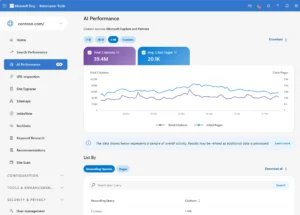
This is a fundamental shift from ranking data to AI citation data.

Key Metrics You Can Now Track
Let’s break down the most important components.
1. Average Cited Pages
This metric shows the number of pages from your site that are cited inside AI summaries.
What this tells you:
- Whether AI considers your site a source of authority
- How broad is your AI visibility is across content
- If your citation footprint is expanding or shrinking
This moves SEO from “Are we ranking?”
to “Are we being referenced?”
And referencing is the new currency.
2. Grounding Queries (Fan-Out Queries)
This is arguably the most powerful feature in the dashboard.
Grounding queries show the expanded phrases or key ideas AI used internally when generating its answer.
In practical terms, this reveals:
- How AI interpreted user intent
- Which semantic themes triggered your citation
- What contextual signals matter most
This gives SEOs something we’ve never had before – insight into how generative engines think.
3. Visibility Trends
This section provides a timeline view of your AI citation activity.
Why this matters:
- You can track whether AI inclusion is growing month-over-month
- You can detect sudden drops in citation activity
- You can correlate content updates with AI visibility changes
AI performance is no longer static.
It’s measurable over time – just like traditional SEO metrics.
4. Page-Level Citations
This metric allows you to see which specific pages are being cited and how often.
This creates new optimization opportunities:
- Identify which content types perform best in AI summaries
- Understand which topics AI considers authoritative
- Replicate high-performing content structures
Instead of guessing what works for AI, you can reverse-engineer it.
Why This Is a Major Industry Moment
Let’s step back.
For years, AI-generated summaries were a black box.
Brands didn’t know:
- Why they were included
- Why competitors were cited
- Whether AI visibility was improving or declining
Now, we have visibility into the visibility.
And that’s powerful.
Because once something is measurable, it becomes strategic.
This update officially confirms:
AI citation is a performance metric.
Ranking vs Referencing: The New Reality
Traditional SEO focuses on ranking position.
AI search focuses on referencing authority.
When someone asks:
“What’s the best CRM for startups?”
AI doesn’t show 10 links.
It synthesizes one answer.
Inside that answer:
- A few brands get named
- A few pages get cited
- The rest are invisible
Those mentions are the new top positions.
And Bing just gave us the scoreboard.
What This Means for Brands and Ecommerce
If you’re a brand owner or CMO, here’s the uncomfortable truth:
You might:
- Rank well
- Get traffic
- Spend heavily on ads
And still not show up inside AI-generated summaries.
That means:
- You lose early-stage influence
- Competitors gain trust faster
- Decision-making happens without you
AI is increasingly becoming the first interface in product discovery.
If you’re not referenced there, you’re missing the front door.
Where GEO (Generative Engine Optimization) Comes In
Generative Engine Optimization focuses on helping brands appear inside AI-generated responses.
Unlike traditional SEO, GEO emphasizes:
- Semantic clarity
- Structured information
- Authority consistency
- Contextual alignment
Bing’s AI Performance report validates that this layer exists – and is measurable.
Now brands can:
- Track AI citations
- Improve content alignment
- Monitor referencing patterns
- Optimize for inclusion
GEO is no longer theoretical.
It’s operational.
The Bigger Picture: AI Visibility + AI Commerce
Being cited is the first step.
The next step is transaction.
As AI integrates deeper into commerce ecosystems through protocols like UCP, the flow becomes:
- AI understands your brand
- AI references your brand
- AI connects to your commerce layer
- AI completes the purchase
If you fail at step one – referencing – you never reach the transaction layer.
Visibility precedes revenue.
Where Two99 Fits Into This Shift
Dashboards create awareness.
Strategy creates advantage.
Two99 helps brands move from understanding AI visibility to capitalizing on it.
At the intersection of:
- AI citation tracking
- Generative Engine Optimization
- AI-first growth systems
- Commerce readiness for AI ecosystems
Two99 helps brands interpret data like Bing’s AI Performance metrics and translate them into sustainable competitive advantage.
Because in the AI era, growth isn’t just about traffic.
It’s about being referenced, trusted, and chosen – before the click ever happens.
Frequently Asked Questions
1. What is Bing’s AI Performance report?
It’s a new feature in Bing Webmaster Tools that provides data on how your pages are cited in AI-generated summaries, including citation counts and visibility trends.
2. What are grounding queries in Bing AI?
Grounding queries are the expanded semantic phrases AI uses internally when generating answers. They show how AI interpreted user intent before selecting sources.
3. How is AI citation different from traditional rankings?
Traditional rankings measure position in search results. AI citation measures whether your content is referenced inside AI-generated summaries.
4. Why is AI visibility important for e-commerce brands?
AI increasingly influences product discovery and decision-making. If your brand isn’t referenced in AI answers, you may lose early-stage influence to competitors.
5. Will Google launch a similar ?
While Google hasn’t yet introduced a dedicated AI citation dashboard, industry observers expect similar reporting as AI search becomes more mainstream.
Key Takeaways
SEO is no longer click-first: Visibility now happens even without a click through AI-generated answers.
Links are losing exclusivity: Rankings still matter, but they’re no longer the only path to discovery.
Content must be answer-ready: Clear, structured, and authoritative content is more likely to be surfaced by AI.
Brand presence > raw traffic: Being cited or referenced matters as much as driving visits.
Optimization shifts from pages to knowledge: SEO is evolving into entity, intent, and trust optimization.