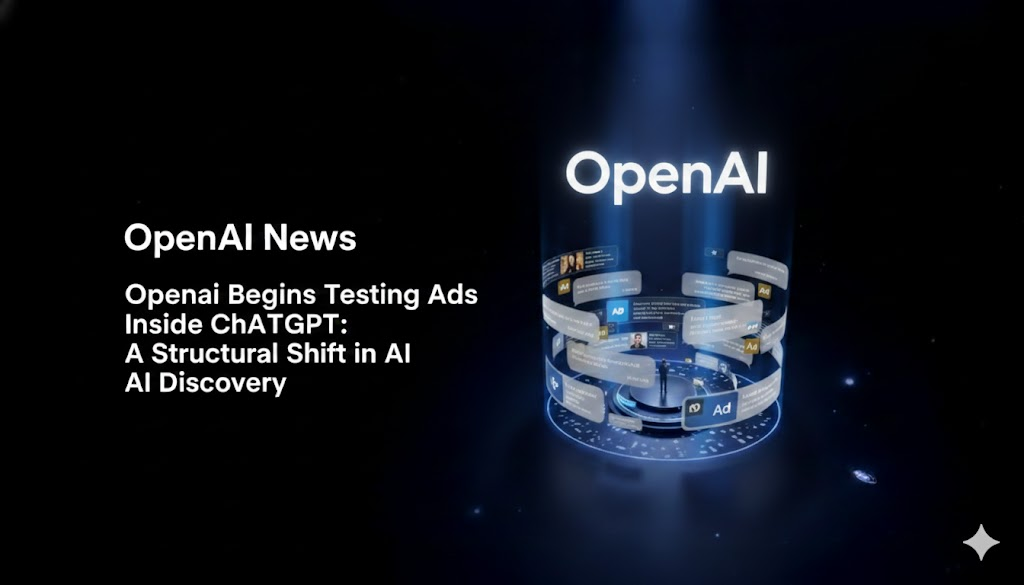
OpenAI has started testing advertisements inside ChatGPT for a limited group of users in the United States. On the surface, this looks like a logical next step for a platform operating at a massive global scale. But beneath the announcement lies a much more meaningful shift, one that changes how discovery, trust, and commercial influence may function like OpenAI Tests Ads in ChatGPT.
This is not just about ads appearing in a new place. It is about AI officially becoming a commercial interface.
What’s New: Ads Inside a Conversational AI Interface
For the first time, sponsored content is being introduced directly into the ChatGPT experience. These ads appear below the model’s responses and are shown only when a sponsored product or service is contextually relevant to the conversation.
OpenAI has been careful to define clear boundaries:
- Ads are visually separated from AI-generated answers
- Sponsored placements are clearly labeled
- Advertisements do not influence or modify ChatGPT’s responses
- The model continues to generate answers based solely on usefulness and relevance
This distinction is critical. The AI’s voice remains informational, while advertising exists as an adjacent layer, not a blended one.

Who Will See These Ads (and Who Won’t)
The current test is intentionally narrow.
Ads are being shown only to:
- Logged-in adult users in the United States
- Users on the free tier
- Users on ChatGPT Go, OpenAI’s lower-cost subscription plan
Ads will not appear for:
- Users under 18
- Subscribers on Plus, Pro, Business, or Enterprise plans
This selective rollout signals that OpenAI is prioritising learning and user feedback before expanding access or formats.
How Ad Targeting Works Without Compromising Privacy
One of the biggest concerns around advertising inside AI tools is data usage. OpenAI has addressed this directly.
Ad placement is based on:
- The context of the current conversation
- The intent implied by the user’s question
It is not based on:
- Past chat history
- Personal user profiles
- Sold or shared conversation data
Users can see why a particular ad appears and have the option to turn off ad personalization. Sensitive categories such as health, mental health, and politics are excluded entirely.
This approach positions ads as situational, not surveillance-driven.
Why OpenAI Is Introducing Ads Now
ChatGPT has evolved from an experimental AI product into a global platform with hundreds of millions of weekly users. Maintaining and scaling a system of this magnitude requires sustained investment.
Behind the scenes, OpenAI continues to invest in:
- High-performance compute infrastructure
- Continuous model training and optimisation
- Safety, moderation, and compliance systems
- Global deployment and uptime reliability
Until now, revenue has primarily come from subscriptions, enterprise partnerships, and API usage. Advertising introduces an additional revenue stream, one that helps subsidise free access and support lower-cost plans without pushing all users toward premium tiers.
Importantly, OpenAI has framed this as an experiment, not a permanent shift, reinforcing its intent to protect user trust while exploring long-term sustainability.
Why This Matters More Than a Typical Monetisation Update
This update changes how digital discovery works.
When advertising enters a conversational AI system, several fundamental dynamics shift:
- Discovery becomes dialogue-based rather than search-based
- Influence becomes embedded within explanations, not banners
- Intent forms in real time, shaped by context and trust
- Brand visibility becomes fluid rather than rank-driven
Users are no longer scrolling, skimming, or clicking through pages. They are asking, reasoning, and deciding with the AI acting as an intermediary.
This makes AI not just a channel, but a decision-making environment.
What This Means for Users
For users, this marks the first meaningful introduction of commercial messaging into an interface that has felt largely neutral and utility-focused.
OpenAI’s design choices, clear labeling, placement below responses, and strict category exclusions suggest an effort to keep advertising from overwhelming the experience. Still, user perception will be the ultimate test.
How users respond to ads inside ChatGPT will heavily influence whether this model expands globally or remains limited in scope.
What This Means for Brands and Marketers
Advertising inside ChatGPT is fundamentally different from search or social advertising.
Here, brands are not competing for clicks; they are appearing alongside reasoning.
Some important implications:
- Ads are triggered by semantic context, not keywords
- The surrounding AI explanation frames how the brand is perceived
- Trust in the AI influences trust in the advertised brand
- Visibility is shaped as much by understanding as by spending
Even with paid placements, brands do not control the narrative. The AI does.
This introduces a new requirement: brands must ensure they are clearly understood by AI systems, not just discoverable by humans.
The Funnel Is Moving Inside AI Interfaces
As conversational AI becomes a primary starting point, the traditional funnel compresses.
- Awareness happens inside AI explanations
- Consideration happens through AI reasoning
- Comparison happens within an AI-generated context
- Purchase intent forms before external clicks
By the time a user reaches a website, much of the decision has already been made.
In this model:
- The website becomes a confirmation layer
- The AI becomes the persuasion layer
The Bigger Picture: AI as the Next Commercial Surface
This test signals the early formation of AI-native advertising environments.
We are likely moving toward:
- Conversational ad networks driven by intent and relevance
- AI-assisted product recommendations embedded in dialogue
- Transaction-ready AI systems integrated with commerce protocols
As AI tools increasingly serve as the first stop for discovery, they will also become the primary space where influence and commercial intent are shaped.
Two99’s Perspective
At Two99, we see this development as confirmation of a broader shift toward AI-first discovery.
Search engines are no longer the only gateways. Social platforms are no longer the sole attention engines. Websites are no longer the first point of persuasion.
The next competitive advantage lies in AI visibility, how clearly, accurately, and consistently a brand is understood by large language models.
OpenAI testing ads inside ChatGPT is not simply a monetisation experiment. It is an early indicator of how AI is becoming a new interface for influence, trust, and commerce.
Final Thought
This moment is not about ads appearing inside ChatGPT. It is about formalising AI as a commercial surface.
The brands that succeed in the coming years will not just rank well or advertise aggressively. They will be the ones that machines understand deeply and surface confidently inside conversations where decisions are already being made.
Key Takeaways
Ads in ChatGPT represent a structural shift toward AI-native discovery and commerce
Visibility inside AI conversations will depend on relevance, trust, and AI interpretation not rankings
Paid ads alone won’t control outcomes; AI still frames meaning and authority
Brands must optimize for AI visibility, entity recognition, and conversational context