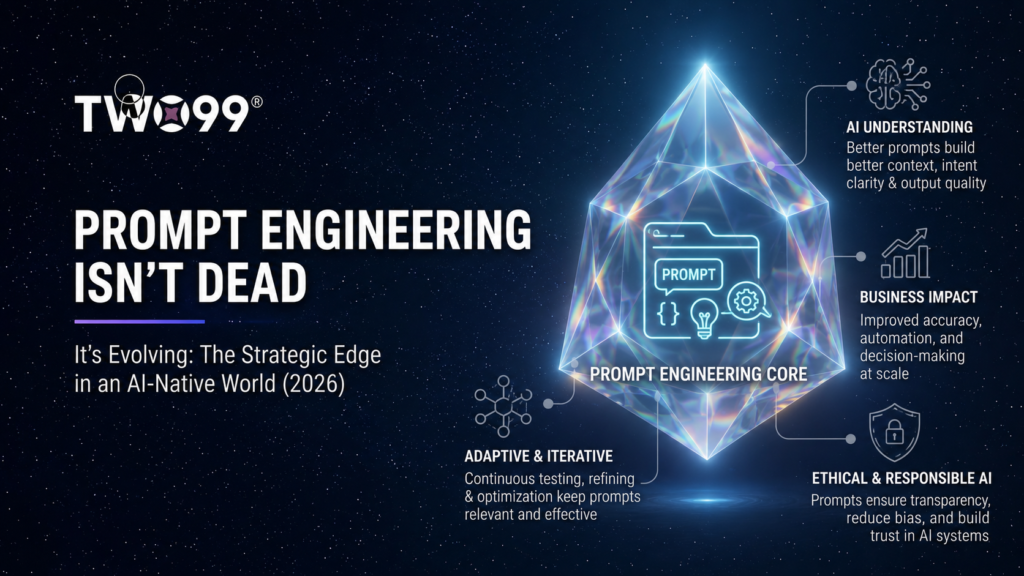
The Evolution of Prompt Engineering
When generative AI first became popular, language models required detailed instructions to produce reliable results. Users had to explain every step, define formatting rules, and provide extensive guidance.
Today’s advanced AI models are far more capable.
Rather than instructing AI step by step, users can simply define:
- The business objective
- The expected outcome
- Important constraints
- The target audience
- The desired quality level
The AI is increasingly capable of determining the intermediate steps on its own, making interactions more natural and efficient.
Prompt Engineering Is Evolving, Not Disappearing
Some headlines suggest that prompt engineering is becoming obsolete. That isn’t entirely accurate.
Writing effective prompts still matters, especially for specialized tasks like coding, research, content creation, and automation. However, prompt engineering is no longer the only factor that determines AI success.
Businesses are now focusing on:
- Context Engineering
- AI Workflow Design
- Business Process Automation
- Knowledge Management
- Data Quality
- AI Governance
- Enterprise AI Integration
In other words, organizations are moving beyond prompts and building complete AI ecosystems.
Why Context Is More Important Than Complex Prompts
Imagine asking an employee to prepare a report without giving any background information. They would naturally have questions about the timeframe, audience, format, and purpose.
Artificial intelligence behaves in much the same way.
Providing AI with rich business context enables it to produce significantly better outputs than simply writing longer prompts.
Examples of useful context include:
- Company documentation
- Product information
- Brand guidelines
- Customer data
- Standard operating procedures
- Previous conversations
- Internal knowledge bases
This is why enterprises are increasingly investing in Retrieval-Augmented Generation (RAG), AI agents, and centralized knowledge systems instead of relying solely on prompt libraries.
Businesses Should Stop Micromanaging AI
Many organizations still interact with AI by breaking every task into multiple instructions.
For example:
- Write a draft.
- Summarize it.
- Rewrite it.
- Create a table.
- Improve the tone.
- Optimize it for SEO.
Modern AI models can often perform all these tasks more efficiently when given the overall objective from the beginning.
Instead of managing every individual step, businesses should define:
- The goal
- The desired output
- The target audience
- Quality expectations
- Business constraints
This approach improves productivity while simplifying AI interactions.
The Real Competitive Advantage Has Changed
As AI technology matures, competitive advantage is no longer determined by who writes the best prompts.
Successful organizations are focusing on:
High-Quality Data
AI performs best when it has access to accurate, organized, and relevant information.
Well-Designed Workflows
Clearly structured business processes allow AI to automate repetitive tasks efficiently.
System Integration
Connecting AI with CRM systems, ERP software, customer support platforms, and internal tools creates measurable business value.
Responsible AI Governance
Security, compliance, human oversight, and ethical AI usage are becoming essential for enterprise adoption.
Essential AI Skills for the Future
Instead of focusing exclusively on prompt writing, professionals should develop broader AI capabilities.
- AI Workflow Design
- AI Automation
- Business Process Optimization
- Context Engineering
- Enterprise AI Integration
- Data Management
- Human-AI Collaboration
- Responsible AI Governance
These skills will remain valuable regardless of how AI models continue to evolve.
What This Means for Businesses
The message for business leaders is encouraging.
Organizations don’t necessarily need employees who can write hundreds of complex prompts. Instead, they need teams that understand how AI can improve productivity, automate repetitive work, and enhance decision-making.
The future of AI is about integrating intelligent systems into everyday operations not simply asking better questions.
Businesses that redesign workflows around AI will gain a stronger competitive advantage than those focusing only on prompt engineering.
How Two99 Solutions Helps Businesses Build Smarter AI Solutions
At Two99 Solutions, we believe AI success extends far beyond writing effective prompts.
We help organizations transform their operations through intelligent, scalable, and customized AI solutions tailored to real business challenges.
Our AI services include:
- Custom AI Application Development
- Enterprise AI Integration
- Generative AI Solutions
- AI Chatbot Development
- LLM Integration
- Workflow Automation
- Business Process Optimization
- AI Consulting & Strategy
Rather than teaching businesses how to create better prompts, we help them build AI-powered systems that improve productivity, streamline operations, reduce costs, and deliver measurable business outcomes.
Frequently Asked Questions (FAQs)
1. Is prompt engineering still important in 2026?
Yes. Prompt engineering remains useful, especially for technical, creative, and specialized tasks. However, businesses are increasingly focusing on context engineering, workflow automation, and AI integration instead of relying solely on complex prompts.
2. Why did Anthropic say prompt engineering is becoming less important?
Modern AI models can understand broader objectives and determine intermediate steps independently. This reduces the need for highly detailed prompts while making AI more accessible to everyday users.
3. What skills are replacing traditional prompt engineering?
Organizations are investing in AI workflow design, automation, context engineering, enterprise AI integration, data management, and AI governance to maximize business value.
4. What is Context Engineering?
Context Engineering is the process of providing AI with the right business information, documentation, knowledge bases, and data so it can generate more accurate and relevant responses.
5. How can businesses prepare for the future of AI?
Businesses should focus on integrating AI into daily operations, improving data quality, automating repetitive workflows, and implementing secure AI governance frameworks.
6. Why choose Two99 Solutions for AI implementation?
Two99 Solutions helps organizations design and implement custom AI solutions, automate business processes, integrate Large Language Models (LLMs), develop AI-powered applications, and create scalable enterprise AI strategies that deliver measurable business outcomes.