Ecommerce is undergoing a structural change. Buying decisions are no longer confined to websites, apps, or even search results. Increasingly, consumers are asking AI systems what to buy, where to buy it, and whether it’s the right choice. In many cases, they expect AI to act on that decision.
This shift toward AI-powered shopping is not just about better recommendations. It marks the rise of AI as an active participant in commerce-one that evaluates options, applies constraints, and executes transactions.
As this behavior becomes mainstream, ecommerce infrastructure needs a new way to communicate with AI systems. That’s where Google UCP, or the Universal Commerce Protocol, comes in.
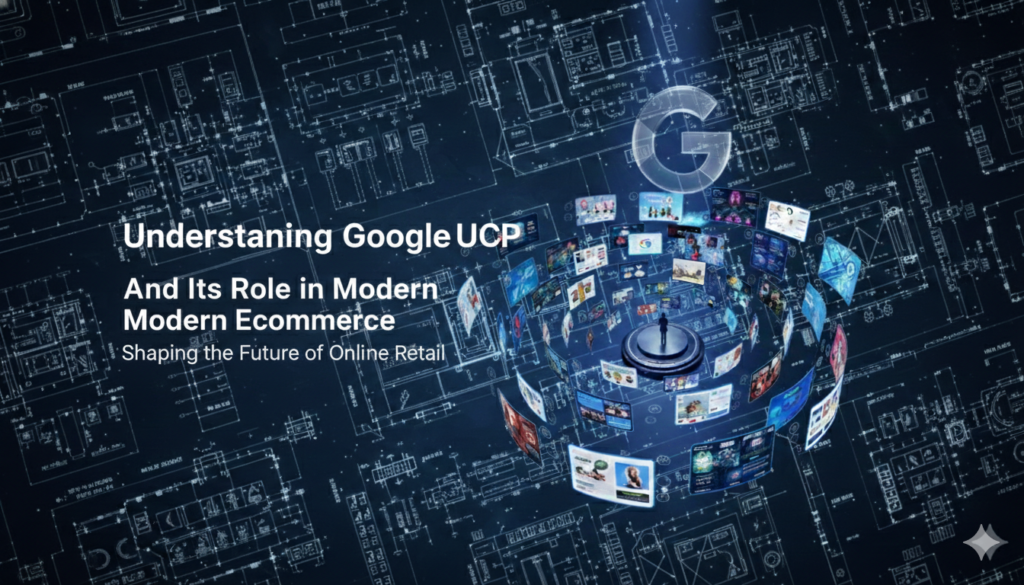
Understanding Google UCP and its role in modern ecommerce is essential for brands and agencies preparing for an AI-first buying environment.
What Is Google UCP?
Google UCP (Universal Commerce Protocol) is a standardized framework that allows AI systems to interact directly with ecommerce platforms. Instead of relying on websites designed for human navigation, UCP exposes commerce capabilities-such as product availability, pricing, cart creation, checkout, and order placement-in a structured, machine-readable format.
In simple terms, UCP enables AI to move from suggesting products to executing purchases safely and predictably.
Rather than building one-off integrations for every merchant, AI platforms can rely on UCP as a shared language for commerce. This makes AI-driven transactions scalable, secure, and consistent across businesses.

Why Google UCP Matters in Modern Ecommerce
Traditional ecommerce was built around human behavior:
- Browsing categories
- Comparing tabs
- Clicking through funnels
- Completing visual checkouts
AI doesn’t behave this way.
AI systems require clarity, defined actions, and predictable outcomes. Google UCP exists to bridge this gap by enabling ecommerce AI integration at the system level.
As AI increasingly mediates discovery and purchasing, brands that are not UCP-compatible risk becoming invisible in these new buying flows-even if they have strong websites or competitive pricing.
UCP and Ecommerce Product Discovery in an AI World
One of the most important impacts of UCP is how it reshapes ecommerce product discovery AI.
In a UCP-enabled environment:
- AI can compare products across merchants in real time
- Pricing and availability are evaluated programmatically
- Policies like delivery, returns, and payment methods influence selection
- The “best” option is synthesized, not browsed
This represents a shift from search-driven discovery to decision-driven discovery, where being clearly understood by AI matters more than simply being visible.
UCP as an Agentic Commerce Standard
Google UCP also functions as an agentic commerce standard.
In agentic commerce, AI agents act autonomously-or semi-autonomously-to complete tasks such as:
- Reordering frequently purchased items
- Finding the most suitable product under constraints
- Executing purchases once confidence thresholds are met
UCP defines:
- What actions AI agents are allowed to perform
- How those actions are authenticated
- How transactions are executed and confirmed
This ensures AI-powered shopping remains safe, auditable, and aligned with both user intent and merchant rules.
Key Google UCP Features for Ecommerce Brands
While UCP operates behind the scenes, its impact is significant. Core Google UCP features include:
- Structured commerce capabilities
Clear definitions of products, pricing, inventory, and allowed actions. - Secure transaction execution
Standardized methods for creating carts, initiating checkout, and placing orders. - Platform-agnostic integration
A universal protocol that reduces dependence on custom integrations. - Scalability for AI systems
Designed to work across AI-driven surfaces like search, chat, and assistants.
Together, these features make UCP a foundational layer for modern ecommerce AI.
Does Google UCP Replace Ecommerce Websites?
No. Google UCP does not replace ecommerce websites-it extends them.
Websites remain essential for:
- Brand storytelling
- Customer education
- Complex product evaluation
- Post-purchase support
What changes is that websites are no longer the only path to purchase. With UCP in ecommerce, AI can bypass traditional funnels when user intent is clear, reducing friction and shortening buying cycles.
UCP Enables Transactions – But Selection Happens Earlier
A critical misunderstanding is assuming that UCP alone guarantees growth.
UCP enables AI-driven transactions, but it does not decide which brand gets chosen. That decision happens earlier, during AI interpretation and evaluation.
AI systems ask:
- Who is this brand?
- What exactly do they sell?
- Are they trustworthy and consistent?
This is where Generative Engine Optimization (GEO) becomes essential.
How Two99 and Genshark Fit Into the UCP Era
Most brands and agencies approach UCP as a technical integration. That’s a mistake.
At Two99, UCP is treated as a strategic shift, not a checklist. Two99 helps brands and agencies understand how AI commerce, UCP, and brand strategy intersect-designing AI-first growth systems rather than retrofitting old funnels.
To make this strategy executable, Genshark plays a central role.
Genshark analyzes how generative AI models interpret a brand’s website, content, and authority signals. It identifies gaps that prevent AI from clearly understanding, recommending, or selecting a brand. This turns GEO from an abstract concept into a measurable discipline-directly improving AI visibility and UCP performance.
Together, Two99 and Genshark enable brands to move beyond “being UCP-ready” and toward being AI-chosen.
Preparing for Google UCP in Ecommerce
To succeed in a UCP-driven ecommerce environment, brands should focus on three layers:
- Commerce readiness
API-accessible pricing, inventory, checkout, and payment logic. - UCP enablement
Clear declaration of commerce capabilities in a standardized format. - AI visibility and trust (GEO)
Ensuring AI systems clearly understand and trust the brand.
Ignoring any one of these limits performance.
Frequently Asked Questions About Google UCP
What is Google UCP in ecommerce?
Google UCP (Universal Commerce Protocol) is a framework that allows AI systems to discover products, evaluate options, and complete purchases directly with ecommerce platforms using structured, machine-readable data.
What role does Google UCP play in modern ecommerce?
Google UCP supports AI-powered shopping by enabling AI systems to move from recommendation to transaction, reducing reliance on traditional websites and funnels.
Is Google UCP an agentic commerce standard?
Yes. UCP defines how AI agents can safely perform commerce actions such as creating carts, initiating checkout, and placing orders.
Does Google UCP replace ecommerce websites?
No. UCP complements websites by enabling AI-driven transactions when intent is clear, while websites remain important for branding and education.
Do brands need to rebuild their ecommerce platforms for UCP?
Most brands do not need a full rebuild, but they do need API-accessible commerce logic and clear, consistent product and policy data.
How does UCP impact ecommerce product discovery?
UCP allows AI to synthesize product data across merchants, shifting discovery from browsing to decision-making driven by relevance and trust.
Is Google UCP only for large ecommerce companies?
No. Small and mid-sized brands can benefit by gaining AI-based discovery and direct transactions without relying solely on marketplaces or ads.
Final Thought: UCP Is the Infrastructure, Not the Advantage
Google UCP provides the execution layer for AI-driven commerce. But execution alone doesn’t win.
The real advantage lies in being clearly understood, confidently evaluated, and consistently chosen by AI systems. That’s where strategy, GEO, and AI-first thinking matter.
With strategic direction from Two99 and AI-interpretation insights from Genshark, ecommerce brands and agencies can move beyond reacting to change and start shaping how AI commerce actually works.
In modern ecommerce, success isn’t about being everywhere.
It’s about being the brand AI trusts enough to buy from.
Key Takeaways
AI is becoming an active buyer in ecommerce
Modern ecommerce is shifting from human-led browsing to AI systems that evaluate, decide, and execute purchases.
Google UCP is the execution layer for AI commerce
UCP provides a standardized, machine-readable way for AI systems to discover products and complete transactions securely.
UCP enables transactions but does not guarantee selection
AI chooses brands based on clarity, trust, and consistency, not just technical compatibility.
GEO determines whether AI trusts and selects a brand
Generative Engine Optimization ensures brands are understood and recommended by AI systems in UCP-driven commerce flows.