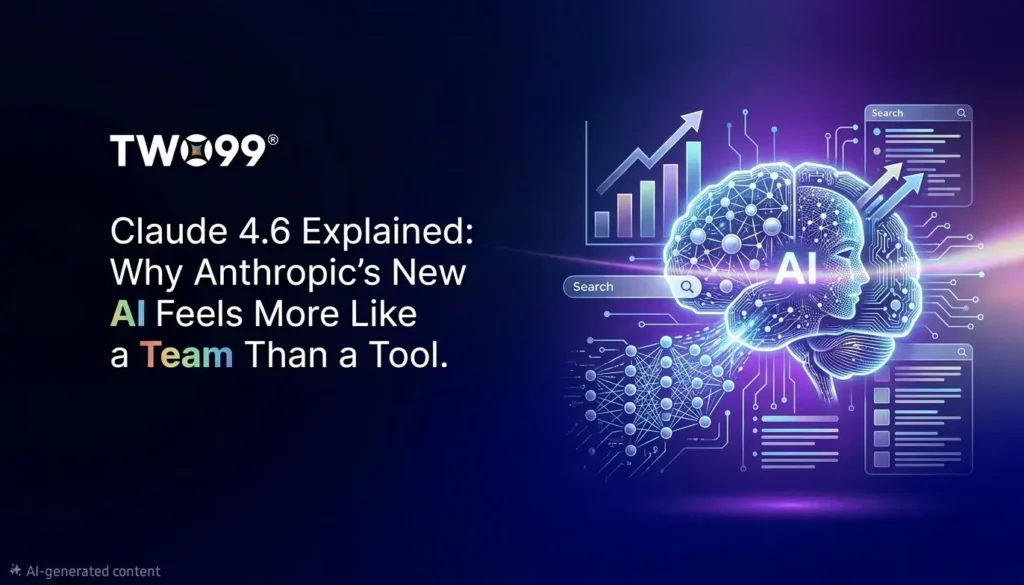
Introduction: Claude 4.6 Explained Beyond Just an AI Upgrade
If you are trying to understand Claude 4.6 explained in the simplest way possible, here is the truth — this is not just another AI update. Claude 4.6 explained properly reveals a shift in how artificial intelligence behaves, moving from a reactive tool to something that feels far more collaborative.
When people search for Claude 4.6 explained, they are not just looking for features. They are trying to understand why this model feels different the moment you start using it. Claude 4.6 explained from a practical standpoint shows that it is no longer about asking questions and getting answers. It is about working alongside a system that understands direction, adapts to complexity, and continues thinking across steps.
This is where Claude 4.6 explained becomes important. It marks the moment AI begins to resemble a working partner rather than a utility.

What is Claude 4.6? Claude 4.6 Explained in Simple Terms
To get Claude 4.6 explained clearly, you need to look beyond technical definitions. At its core, Claude 4.6 is an advanced AI system developed by Anthropic that focuses on handling complex, multi-layered tasks with continuity.
Claude 4.6 explained simply means an AI that can:
- Understand long context
- Maintain logical consistency
- Execute multi-step workflows
- Improve its own outputs over time
Unlike earlier systems where every interaction felt isolated, Claude 4.6 explained shows how the model keeps track of your intent across an entire session. It does not just respond. It builds.
When you truly see Claude 4.6 explained, you realize it is designed for people doing serious work — researchers, developers, strategists, and professionals who need more than surface-level outputs.
Why Claude 4.6 Feels Like a Team: Claude 4.6 Explained Practically
One of the most common observations when people experience Claude 4.6 explained in real usage is that it feels less like software and more like collaboration.
This happens because Claude 4.6 explained includes the ability to:
- Understand the broader objective
- Break tasks into logical steps
- Maintain continuity across those steps
- Refine outputs without being asked repeatedly
When you interact with it over time, Claude 4.6 explained starts to feel like multiple roles working together. It can behave like a researcher when gathering insights, a writer when structuring content, and a reviewer when refining it.
That layered behavior is exactly why Claude 4.6 explained is often described as a team rather than a tool.
The Shift from Prompts to Workflows: Claude 4.6 Explained in Action
To truly understand Claude 4.6 explained, you need to see how it handles workflows instead of isolated prompts.
Traditional AI tools operate in a simple loop. You give an input, and you get an output. If the output is incomplete, you refine the prompt and repeat the process.
Claude 4.6 explained changes this dynamic completely.
Instead of treating each request independently, it works through problems as ongoing processes. When you give it a task, it does not just complete one step. It considers what comes next, what is missing, and how everything connects.
This is where Claude 4.6 explained becomes powerful for professionals. Whether you are building a strategy, writing long-form content, or solving a technical problem, the system stays aligned with your goal throughout.
Deep Context Understanding: Claude 4.6 Explained at Scale
A major part of Claude 4.6 explained is its ability to handle extremely large context without losing clarity.
In earlier AI systems, long conversations often led to confusion. Important details would be forgotten, and the user had to reintroduce context repeatedly.
Claude 4.6 explained removes that friction.
It can process long documents, maintain consistency across extended discussions, and understand relationships between different parts of a task. This makes it especially valuable for:
- Research work
- Technical documentation
- Long-form content creation
- Business strategy development
When you experience Claude 4.6 explained in such scenarios, the difference becomes immediately clear. It does not just remember — it understands.
Adaptive Thinking: Claude 4.6 Explained Like Human Reasoning
Another key aspect of Claude 4.6 explained is how it adapts its thinking based on the complexity of the task.
Most AI tools respond at a fixed level of reasoning. Claude 4.6 explained shows a different approach. It evaluates whether a task is simple or complex and adjusts accordingly.
For quick tasks, it responds efficiently.
For deeper problems, it expands its reasoning and explores multiple layers.
This is why Claude 4.6 explained feels more natural. It mirrors how humans think. We do not approach every task with the same intensity, and neither does this model.
Multi-Step Execution: Claude 4.6 Explained for Real Work
When you look at Claude 4.6 explained from a workflow perspective, one of its biggest strengths is its ability to maintain direction across multiple steps.
In real-world scenarios, work is rarely linear. It involves iteration, correction, and refinement. Claude 4.6 explained supports this entire process without losing alignment.
For example, when working on a long document, Claude 4.6 explained ensures that:
- The tone remains consistent
- The structure stays intact
- The argument flows logically
This level of continuity is what makes it suitable for serious, high-quality work.
Self-Improvement and Review: Claude 4.6 Explained as a Dual Role System
Another reason Claude 4.6 explained feels like a team is its ability to act as both creator and reviewer.
After generating content or solving a problem, it can revisit its own output and improve it. This reduces the need for multiple back-and-forth iterations.
Claude 4.6 explained in this sense becomes a system that:
- Creates
- Evaluates
- Refines
This layered capability is rarely seen in traditional AI tools and is one of the strongest indicators of its evolution.
Real-World Applications: Claude 4.6 Explained in Practical Use
Understanding Claude 4.6 explained becomes much clearer when you look at how it performs in real-world situations.
In software development, it can work through complex code, identify issues, and suggest improvements while maintaining awareness of the entire system.
In research, Claude 4.6 explained allows users to process large volumes of information, extract insights, and structure them into meaningful outputs.
In business strategy, it helps in building structured plans, analyzing scenarios, and refining ideas with clarity.
Across all these use cases, the common theme remains the same. Claude 4.6 explained is not just responding. It is contributing.
Expert Insight: Claude 4.6 Explained as the Beginning of Agentic AI
From a broader perspective, Claude 4.6 explained represents a shift toward what experts call agentic AI.
This means moving away from simple interactions toward systems that can handle complete objectives.
Instead of: Prompt → Response
We now have: Goal → Process → Execution → Refinement
Claude 4.6 explained is one of the earliest examples where this transition is clearly visible in real-world usage.
Pro Tips to Use Claude 4.6 Effectively
To fully benefit from Claude 4.6 explained, it is important to change how you interact with AI.
Start by focusing on outcomes rather than isolated prompts. Provide context, allow the system to process it, and work collaboratively instead of controlling every step.
The more you treat Claude 4.6 as a thinking partner, the more value it delivers.
Conclusion: Claude 4.6 Explained in One Clear Thought
If you had to summarize Claude 4.6 explained in one line, it would be this: It is not just an AI that answers. It is an AI that works with you.
Claude 4.6 explained marks a shift from tools to systems, from responses to workflows, and from assistance to collaboration.
That is why it feels different. And that is why it matters.
FAQs
1. What is Claude 4.6 and why is it different?
Claude 4.6 explained shows that it is an advanced AI model designed to handle complex workflows rather than just simple prompts. Unlike earlier tools, it maintains context, understands long tasks, and contributes across multiple steps. This makes it more useful for professional work where continuity and depth are required.
2. Why does Claude 4.6 feel like a team instead of a tool?
Claude 4.6 explained feels like a team because it can perform multiple roles within a single interaction. It can research, write, analyze, and refine outputs without needing constant direction. This layered behavior creates the experience of working with multiple contributors rather than a single system.
3. How does Claude 4.6 handle long and complex tasks?
Claude 4.6 explained demonstrates strong performance in handling long tasks by maintaining context across extended inputs. Whether it is a long document or a multi-step project, it keeps track of details and ensures consistency, which is essential for high-quality outputs.
4. Is Claude 4.6 suitable for beginners?
Claude 4.6 explained can be used by beginners, but it delivers the most value to users who are working on complex tasks. Beginners can still benefit from its clarity and structured responses, but professionals will notice a deeper impact in their workflows.
5. Can Claude 4.6 replace human professionals?
Claude 4.6 explained clearly shows that it is not a replacement for human expertise. Instead, it enhances productivity by handling repetitive and structured tasks. Human judgment, creativity, and decision-making remain essential.
6. What industries benefit the most from Claude 4.6?
Claude 4.6 explained is particularly useful in industries like software development, research, content strategy, finance, and consulting. These fields require deep thinking and structured workflows, which align well with its capabilities.
7. How is Claude 4.6 different from other AI models?
Claude 4.6 explained stands out because of its ability to maintain long context, adapt its reasoning, and execute multi-step tasks. Most AI models focus on generating responses, while Claude focuses on completing workflows.
8. Does Claude 4.6 improve its own outputs?
Yes, Claude 4.6 explained includes the ability to review and refine its own work. This reduces the need for repeated prompts and improves the overall quality of the final output.
9. What is the future of AI like Claude 4.6?
Claude 4.6 explained represents the beginning of a shift toward collaborative AI systems. In the future, AI will likely function as integrated teams that handle different parts of a task simultaneously.
10. Should I use Claude 4.6 for professional work?
Claude 4.6 explained makes it clear that it is highly suitable for professional work, especially when tasks involve multiple steps, large context, and continuous refinement. It can significantly improve efficiency and output quality.
Key Takeaways
From Tool to Teammate – Claude 4.6 behaves like a collaborative partner, handling tasks across multiple roles such as research, writing, and review.
Workflow-Oriented AI – It shifts from prompt-response interactions to full workflow execution, maintaining direction across complex tasks.
Deep Context Understanding – Claude 4.6 can process long inputs and maintain consistency, making it ideal for research and long-form projects.
Adaptive Reasoning – The model adjusts its thinking depth based on task complexity, mimicking human-like problem-solving.
Foundation for Agentic AI – It represents the early stage of agentic AI, where systems move from answering questions to completing objectives.