Introduction & Executive Summary
Welcome to the era of “Agentic Commerce.”
For the last 30 years, the internet has been built for human eyes. Websites are designed with colorful banners, pop-up ads, and layout tricks meant to keep you scrolling. While this is great for browsing, it is terrible for getting things done efficiently. Every time you want to buy something, you have to act as a manual data-entry clerk—typing your address, credit card, and passwords over and over again.
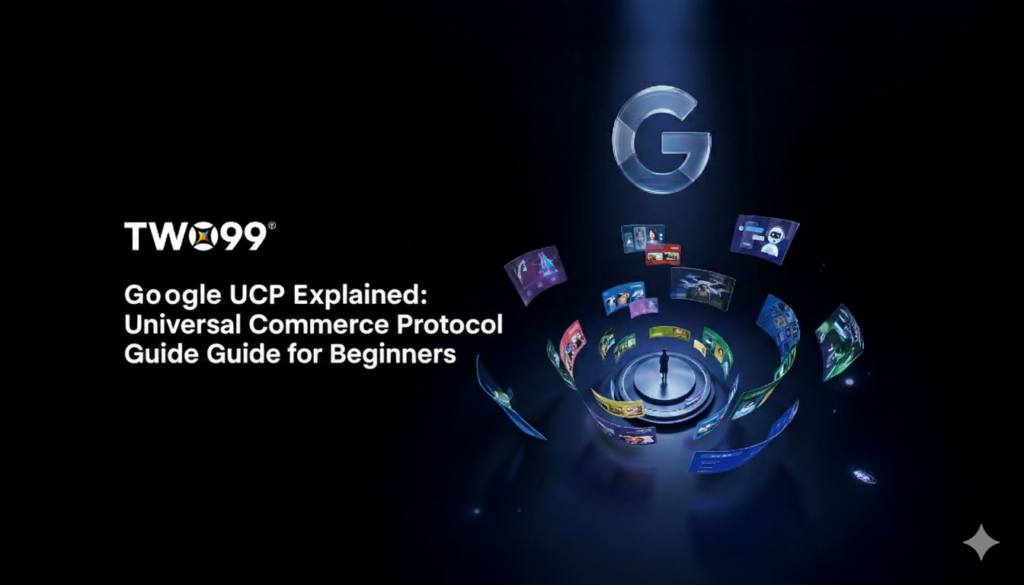
Google UCP (Universal Commerce Protocol) is the infrastructure change that fixes this. Announced in January 2026, it is a new “common language” that allows online stores to talk directly to AI agents. It transforms the internet from a library of visual pages into a menu of actionable data, allowing your AI assistant to handle the boring parts of shopping for you.
The “TL;DR” Summary
- What is it? A standard set of rules that lets online stores (like Walmart, Shopify, or local boutiques) “speak” to AI assistants (like Gemini) in a common language.
- What does it do? It allows an AI to find products, check inventory, negotiate prices, and complete purchases without you ever visiting a website.
- Why does it matter? It removes the “friction” of the internet. No more cookie banners, no more “create account” forms, and no more forgotten passwords.
- Is it safe? Yes. It works on a “permission” basis. You give the AI a budget (e.g., “Spend up to $50”), and it cannot exceed that limit without your biometric approval.
Complete Breakdown & Analysis

Part 1: What is it? (The “5-Year-Old” Explanation)
Imagine if every store in the mall spoke a different language.
- To buy shoes, you have to speak French.
- To buy pizza, you have to speak Japanese.
- To buy a toy, you have to speak German.
If you sent a robot (an AI) to buy things for you, the robot would be confused because it doesn’t know all those specific languages perfectly. It might accidentally order a “shoe” when you wanted a “slice” because it misunderstood the local dialect of that specific store.
Google UCP (Universal Commerce Protocol) is like a rule that says: “Okay, everyone in the mall must now speak English when talking to robots.”
It is a new standard that lets AI assistants (like Google Gemini) talk directly to online stores (like Walmart, Shopify, or a local boutique) to buy things for you, so you don’t have to visit the website yourself. It creates a “common tongue” for digital shopping, ensuring that when an AI asks “How much is this?” every store answers in the exact same format.
Part 2: The “Universal Remote” Analogy
To understand why this is such a big deal, think of online shopping right now like your home entertainment system in the 1990s.
You have 10 different remotes on your coffee table:
- One for the TV.
- One for the Soundbar.
- One for the DVD player.
- One for the Cable box.
Every time you want to do something simple, you have to pick up a different remote (visit a different website), figure out which buttons to press, and hope the batteries aren’t dead. It is clumsy and annoying.
Google UCP is the Universal Remote.
It lets one device (the AI) control everything. It connects the AI directly to the store’s inventory and checkout counter. Instead of you navigating ten different websites (picking up ten remotes), you just tell the Universal Remote what you want to watch, and it handles the input switching, volume, and power automatically.
Part 3: The Pain of the “Old Internet” (Why We Need This)
Before we look at the solution, let’s really look at the problem. We have become so used to the friction of the internet that we don’t realize how bad it is.
When you shop online today, you are actually doing manual data entry work. You are a human bridge connecting isolated islands.
- The “Cookie” Wall: Every site demands you accept cookies, blocking your view until you click “Accept.”
- The “Login” Wall: You have to remember if you have an account, or reset your password for the 50th time.
- The “Form” Fatigue: You type your name, address, and credit card number over and over again, even though you have done it thousands of times before.
The internet is built for human eyes—pretty pictures, big buttons, and layouts designed to make you stay longer. It isn’t built for efficiency. UCP changes the internet from a “Place to Visit” into a “Service to Call.”
Part 4: Use Case 1 – “The Lazy Sunday” (Simple Transaction)
Here is a side-by-side comparison of how you shop without UCP vs. with UCP for a single item.
Scenario: You want to buy a specific pair of running shoes.
– The Old Way (Without UCP)
- You search “Red running shoes size 10” on Google.
- You see a link and click it.
- Wait for the Nike website to load (it’s heavy with ads).
- You scroll past a banner for a sale you don’t care about.
- You click “Add to Cart.”
- You click “Checkout.”
- Pop-up: “Create an account for 10% off?” (You click ‘No’).
- You select “Checkout as Guest.”
- You type in your shipping address (again).
- You type in your credit card number (again).
- You hit “Buy.”
Total Time: 4–8 minutes. Frustration Level: Low to Medium.
– The New Way (With Google UCP)
- You are chatting with your AI assistant (Gemini).
- You say: “Find me those red running shoes in size 10 and buy them.”
- The AI uses UCP to “shake hands” with the store in the background. It bypasses the website completely and talks directly to the inventory database.
- The AI says: “Found them at Foot Locker for $80. I used your default card and address. They will arrive Tuesday.”
- Done. You never left the chat app.
Total Time: 15 seconds. Frustration Level: Zero.
Part 5: Use Case 2 – “The Impossible Errand” (Complex Transaction)
Where UCP truly shines isn’t just buying one thing; it is coordinating many things. This is where the “Universal Language” aspect becomes powerful.
Scenario: You are hosting a last-minute dinner party.
– The Old Way
You need steaks, a specific wine, and a new tablecloth.
- You go to a grocery app for the steaks. You browse, add to cart, checkout.
- You go to a wine delivery app. You search for the vintage, add to cart, checkout.
- You go to Amazon for the tablecloth. You search, read reviews, add to cart, checkout.
You are managing three different delivery windows, three different tracking numbers, and three different receipts.
– The New Way (With UCP)
You say to your AI: “I’m hosting a steak dinner for 4 tonight. Get me 4 ribeyes from Whole Foods, a bottle of 2018 Cabernet from the liquor store, and a white tablecloth delivered by 6 PM.”
The UCP Magic:
- Broadcast: The AI sends a UCP signal: “Who has steaks? Who has wine? Who has tablecloths?”
- Negotiation: The stores reply instantly in the UCP language.
- Whole Foods: “I have steaks. $40.”
- Liquor Store: “I have the wine. $25.”
- Target: “I have the tablecloth. $15.”
- Bundle: The AI bundles this into one confirmation for you.
- Execution: It executes three separate payments simultaneously using your authorized digital wallet.
You essentially hired a General Contractor (the AI) to manage the Sub-Contractors (the stores).
Part 6: How It Works (The “Drive-Thru” Mechanism)
You might be wondering: “How does the AI skip the website?”
Think of a website like a Sit-Down Restaurant.
- You have to park (go to the URL).
- Walk in (wait for load).
- Read the menu (browse pages).
- Talk to the waiter (search bar).
- Wait for the food.
- Pay the cashier.
Google UCP builds a high-speed Digital Drive-Thru Window for every restaurant, but this drive-thru is only for robots.
- Discovery: The AI “drives up” and scans a digital code that lists the entire inventory instantly.
- Negotiation: The AI asks, “Do you have this in stock?” The store’s computer replies “Yes” instantly.
- Transaction: The AI passes your digital “token” (payment info) through the window.
- Fulfillment: The store hands over the receipt.
Because the AI doesn’t need to “look” at the menu (images, CSS, layout), this conversation happens in milliseconds.
Part 7: The Safety Question (Is my wallet safe?)
A common worry: “If the AI can buy things, will it bankrupt me?”
UCP is designed with “Permissions” at its core. It works like a corporate credit card or a child’s allowance debit card.
- The “Allowance” Limit: You set a rule: “You can spend up to $50 on groceries without asking. Anything over $50 requires my thumbprint.”
- The “Trusted Vendor” List: You can tell UCP: “Only buy from verified stores with 4+ stars” or “Only buy from Amazon and Walmart.”
- Privacy Shield: When the AI talks to the store, it doesn’t have to give your real email address. It can use a “relay” email (like a burner phone number) so the store can’t spam you with marketing emails later.
Part 8: Creative Video Script
To visualize this difference, here is a creative script concept.
Title: “The Butler & The Maze” Length: 30 Seconds Characters:
- USER (A guy relaxing on a couch).
- ALFRED (A human dressed as a butler, representing the AI).
- THE MAZE (An obstacle course representing websites).
(Scene 1: The Old Way) Music: Chaotic, fast-paced circus music.
USER: Alfred, get me some batteries! ALFRED: Certainly, sir! (Alfred turns and sprints toward a door marked “STORE.” Suddenly, he is blocked by a velvet rope. A sign pops up: “CREATE ACCOUNT.” Alfred scribbles furiously on a clipboard. He runs forward again but hits a brick wall labeled: “COOKIE CONSENT.” He has to climb over it. He lands, runs two steps, and trips over a tripwire labeled: “FORGOT PASSWORD.” Alfred falls face first into the mud. He looks up, exhausted, sweaty, and defeated.)
(Scene 2: The New Way – Google UCP) Music: Smooth, futuristic elevator jazz.
USER: Alfred, get me some batteries. ALFRED: (Smiling, standing perfectly still) Already done, sir. (Alfred doesn’t move a muscle. He simply holds up a small, glowing transparent tablet. On the screen, a green checkmark appears instantly.)
ALFRED: I used the UCP tunnel, sir. No walls. No passwords. Just batteries.
USER: (Takes a sip of coffee) Nice.
(Text on Screen: Google UCP. The Fast Lane for AI Shopping.)
Part 9: Why This Matters for the Future
If Google UCP becomes the standard, the internet changes.
- Small Business Wins: Right now, you buy from Amazon because it’s easy. Even if a small local shop has the item cheaper, their website is usually clunky, so you skip it. With UCP, the AI doesn’t care if the website is clunky. It only looks at the data (Item + Price + Delivery). This levels the playing field for small businesses.
- The Death of “Browsing” for Chores: We will still browse for fun (looking at vacation photos, fashion trends), but we will stop browsing for chores (batteries, toilet paper, replacement cables). Those boring tasks will be handed off to the AI entirely.
Google UCP is the infrastructure that turns the internet from a library of pages into a menu of actions. It is the moment the computer finally starts working for us, instead of us working for the computer.
Key Takeaways
Clear understanding of the core concept:
This piece breaks down Google’s Universal Commerce Protocol in simple language, making a complex infrastructure shift easy to understand even for non-technical readers.
Actionable insight into real-world impact:
Through practical scenarios, it shows how AI-driven commerce will actually work in daily life, not just in theory.
Best practices and friction points explained:
The content highlights what currently slows users down online and how UCP removes those barriers entirely.
Strategic relevance for businesses and leaders:
It explains why this shift matters for brands, platforms, and decision-makers preparing for AI-led buying behavior.